
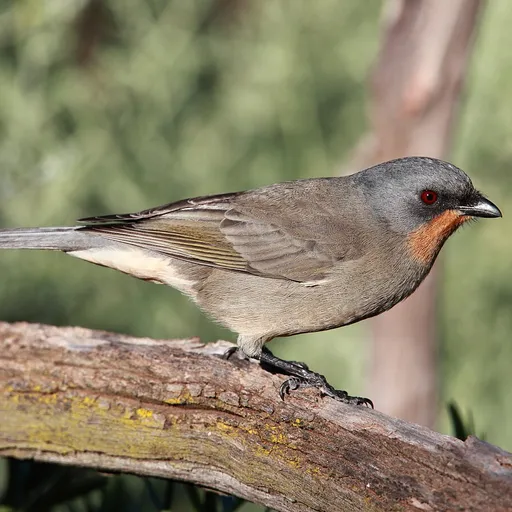
Gilbert's Whistler
Pachycephala inornata
Least Concern
Overview
Gilbert's whistler (Pachycephala inornata) is a monotypic species of bird endemic to Australia, where it resides in scattered semi-arid zones of the south. Classified as Least Concern on the IUCN Red List, it remains listed as vulnerable in New South Wales due to declining populations and distribution.
Identification
- Adult males possess a rufous chin and throat from their third year, whereas females have a pale grey throat and a white ring around the eye.
- Both sexes are uniformly brownish-grey with a red iris and a black, stubby bill measuring 17–18 mm.
- Its loud, melodious song is often heard up to 900 m away and consists of a series of swelling cheop, cheop, cheop notes repeated five to 20 times, accompanied by an ascending er-WHIT call and a scratchy eechowk.
Habitat
The species inhabits semi-arid tall mallee, prickly Acacia thickets, and Casuarina or Melaleuca woodlands, occasionally found in taller eucalypt woodlands. Its distribution is scattered across southern Western Australia, South Australia, northwestern Victoria, and central western New South Wales, favouring habitat that has been burnt between 30 and 60 years previously.
Diet
Gilbert's whistlers feed primarily on invertebrates, supplemented by fruit and seeds. They forage mostly on the ground and in understorey layers, a behaviour shared by many declining bird species in southern Australia.
Did you know?
Despite often being described as having plain plumage, the bird is more often heard than seen, with its loud calls capable of travelling up to 900 metres. It also builds deep cup nests in dense shrubs, frequently constructing its home on top of old babblers' nests.
Sources
- Wikipedia · CC BY-SA 4.0
- Wikidata · CC0 1.0