
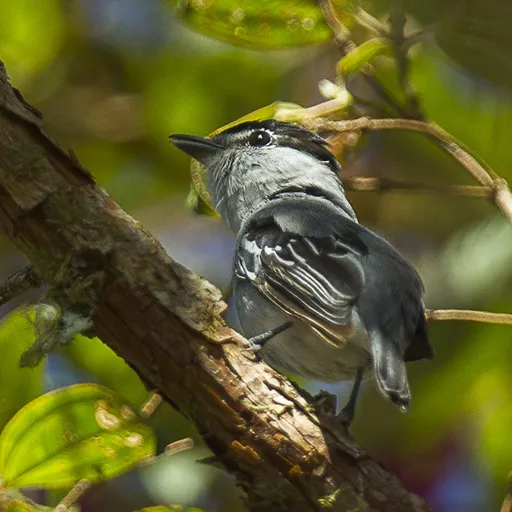
Black-and-white Becard
Pachyramphus albogriseus
Least Concern
Listen
XC249820 · Niels Krabbe · Morona-Santiago: w-slope Cord. de Cutucú, Ecuador · CC BY-SA 4.0
Overview
The black-and-white becard (Pachyramphus albogriseus) is a species of bird in the family Tityridae. It is found across northern South America and Central America, with its status on the IUCN Red List classified as Least Concern.
Identification
- Males feature a glossy bluish black crown, a wide white stripe above the eye, and gray upperparts, while females have a chestnut-brown crown with a black band and yellowish olive underparts.
- The wings are mostly black with white or cinnamon edges that form wing bars, and the tail is black on top with pale gray or cinnamon-tipped underside.
- It measures 13.2 to 15.0 cm in length and possesses a gray bill and dark gray legs with yellowish soles.
- The song is described as a short soft phrase of three mellow notes, 'w-tuw-tuweet', while the call is a rapid trill of downslurred notes.
Habitat
This species inhabits humid foothill and montane forests with dense understories, generally found at varying elevations between 500 and 3,200 m. Its distribution is disjunct, covering northwestern Costa Rica, western Panama, and scattered locations in Colombia, Venezuela, Ecuador, and Peru.
Diet
The black-and-white becard feeds on large insects and small fruits, foraging primarily in the upper understory to the canopy. It usually forages singly or in pairs, taking food from foliage with short fluttery sallies, and occasionally joins mixed-species feeding flocks.
Did you know?
The taxonomy of this species has been unsettled; a 2023 study reduced the number of recognised subspecies from five to two, though some authorities retain the older classification.
Sources
- Wikipedia · CC BY-SA 4.0
- Wikidata · CC0 1.0