
Chestnut-crowned Becard
Pachyramphus castaneus
Least Concern
Listen
XC249098 · Niels Krabbe · Orellana: 'Maxus' road km 37 (27 km SSE Pompeya), Ecuador · CC BY-SA 4.0
Overview
The chestnut-crowned becard (Pachyramphus castaneus) is a small bird belonging to the family Tityridae, commonly known as the tityras. It is classified as Least Concern by the IUCN Red List, though its population is believed to be decreasing despite a large range across South America.
Identification
- Approximately 14 to 15 cm long and weighing about 17 g, with sexes sharing similar plumage.
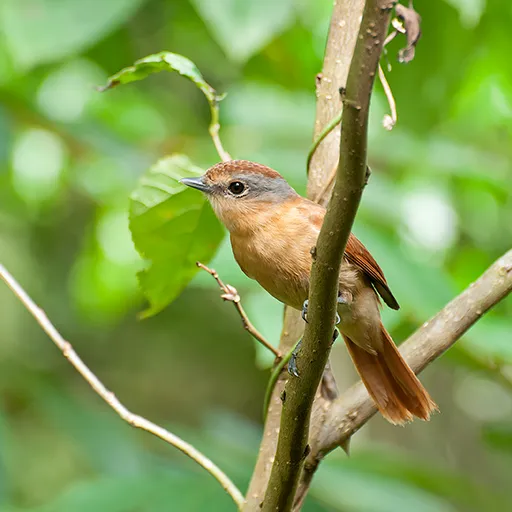
- Adults of the nominate subspecies feature a dark chestnut-rufous crown with a scaly appearance, dusky lores, and pale buff-whitish lines above the lores.
- Upperparts are mostly cinnamon-rufous with dusky cinnamon wings, while underparts are pale cinnamon-buff, becoming paler on the throat.
- Song consists of a simple series of four to five very high-pitched "weeu---" notes or soft, thin whistles such as "teeuw-teeu-teeu".
Habitat
Found in a disjunct distribution across Argentina, Bolivia, Brazil, Colombia, Ecuador, Peru, Paraguay, and Venezuela. In the Amazon Basin, it inhabits humid terra firme and várzea lowland forests, favouring edges and clearings with tall trees, as well as riparian forests, secondary woodlands, and coffee plantations. Elevation ranges from sea level to 1,000 m, though it can reach 1,700 m in Venezuela.
Diet
Feeds on large insects, including caterpillars, and occasionally consumes berries. Typically forages in pairs or singly, usually avoiding mixed-species feeding flocks. Foraging occurs mostly in the upper levels of the forest, involving gleaning from perches, short sallies, and occasional brief hovering.
Did you know?
The nest is a messy globe constructed from grass and plant fibres with a downward-facing entrance hole at the bottom, typically wedged in a branch fork within the mid-story to canopy of the forest.
Sources
- Wikipedia · CC BY-SA 4.0
- Wikidata · CC0 1.0