
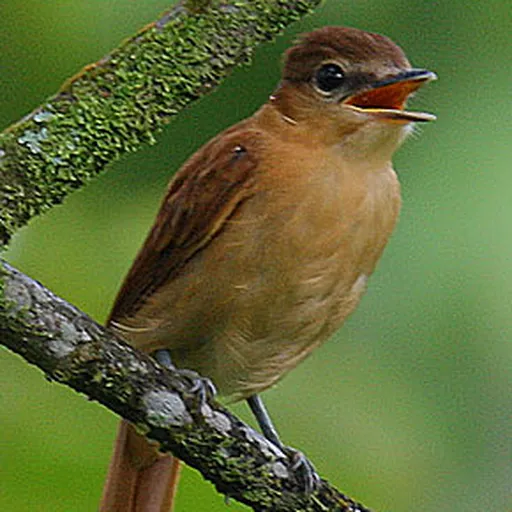
Cinnamon Becard
Pachyramphus cinnamomeus
Least Concern
Listen
XC248191 · Niels Krabbe · Esmeraldas: 18.5 road km NNW Alto Tambo, Ecuador · CC BY-SA 4.0
Overview
The cinnamon becard, Pachyramphus cinnamomeus, is a passerine bird in the family Tityridae found in Mexico, Central America, and parts of northern South America. It is classified by the IUCN as being of Least Concern, with an estimated population of at least 50,000 mature individuals.
Identification
- A 14 to 15 cm long bird weighing 17 to 22 g with deep rufous or chestnut-rufous upperparts and ochraceous tawny underparts that are paler on the throat and belly.
- Features a deep rufous crown, dusky lores, and a pale buff line above the lores, with a rufous tinge across the breast.
- Possesses a dark iris, a blackish bill that is often paler and grayish on the mandible, and dark gray legs and feet.
- Produces a plaintive, reedy song described as a fast or nearly trilled series of musical notes such as 'teedeedee-deedeedee' or 'cheei dee-dee'.
Habitat
Inhabits the interior and edges of evergreen and secondary forest in tropical and lower subtropical zones, extending to open woodlands, riparian areas, clearings with tall trees, and coastal mangroves. Its range covers Mexico, all Central American countries except El Salvador, and Colombia, Ecuador, and Venezuela. Elevation ranges from sea level to 1,200 m, with variations depending on the region.
Diet
Feeds on a variety of insects, other arthropods, and berries. Usually forages singly or in pairs, though occasionally in small groups or mixed-species flocks. Perches from the forest's mid-story to the canopy and takes food by gleaning from vegetation and twigs with a short sally.
Did you know?
Nests are often placed near an active wasp nest, and the female alone incubates the clutch of three or four eggs for about 18 to 21 days.
Sources
- Wikipedia · CC BY-SA 4.0
- Wikidata · CC0 1.0