
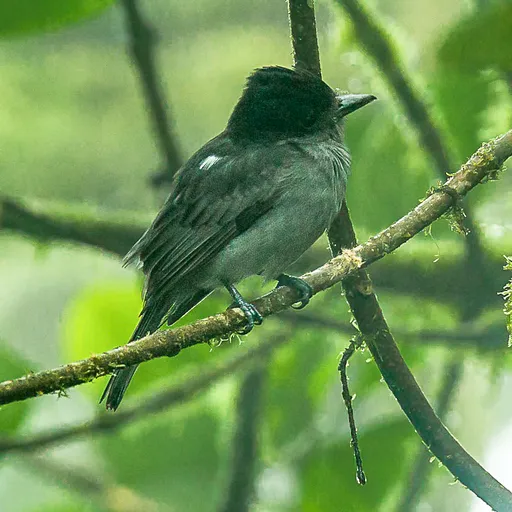
One-colored Becard
Pachyramphus homochrous
Least Concern
Listen
XC250357 · Niels Krabbe · Loja: Tambo Negro 10 km E Macará, Ecuador · CC BY-SA 4.0
Overview
The one-colored becard (Pachyramphus homochrous) is a species of bird in the family Tityridae, classified as Least Concern on the IUCN Red List. It is found across parts of Colombia, Ecuador, Panama, Peru, and Venezuela, where it typically inhabits a variety of tropical forest types.
Identification
- Size and Weight: Approximately 16.5 cm (6.5 in) long and weighing around 35 g (1.2 oz).
- Plumage: Sexually dimorphic; adult males are mostly dark slaty gray with a faint pinkish wash on the throat, while females feature rufous-chestnut upperparts and buffy-cinnamon underparts with a whitish cinnamon spot above the lores.
- Song: Produces a rather variable, loud, and sharp sputtering or chattering call, often described as "stet-ee-ee-teet-tsit-tsit-tsitts-tsít or ske-e-et’et’ittt, tseer, tsrip", and frequently gives a squeaky, high-pitched "tweíuuw".
Habitat
This species inhabits humid evergreen, dryer deciduous, and gallery forests, as well as secondary forests, clearings, and arid scrublands with tall trees. It is generally found from sea level to 900 m (3,000 ft), though it reaches higher elevations in specific regions, such as 1,500 m (4,900 ft) in Ecuador. Its range covers central and eastern Panama, the Pacific slope of Colombia and Ecuador, northwestern Peru, and parts of Colombia and Venezuela.
Diet
The one-colored becard feeds on insects and fruit, foraging primarily from the forest's mid-story to its subcanopy, usually at the forest edges. It usually forages in pairs, although it sometimes forages singly or joins mixed-species feeding flocks with roughly equal frequency.
Did you know?
Nest construction involves building irregular balls from dry grass and weeds, lined with feathers and soft plant material, which are hung from tree branches between 4 and 14 m (15 and 45 ft) above the ground. These nests contain clutches of three or four eggs, with young estimated to fledge 24 to 29 days after hatching.
Sources
- Wikipedia · CC BY-SA 4.0
- Wikidata · CC0 1.0