
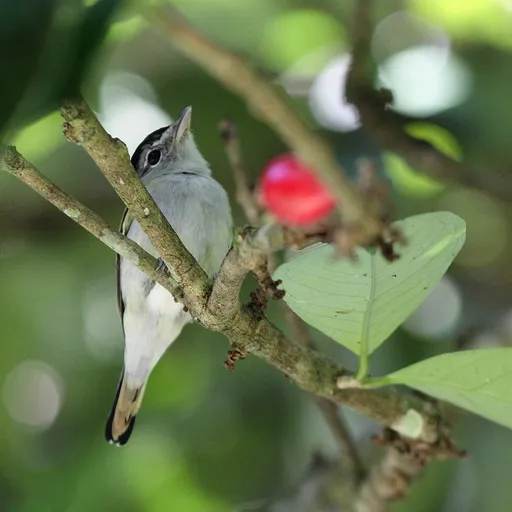
Black-capped Becard
Pachyramphus marginatus
Least Concern
Overview
The black-capped becard (Pachyramphus marginatus) is a species of bird in the family Tityridae found across various countries in South America. It comprises two subspecies and is currently assessed as Least Concern by the IUCN, though its population is believed to be decreasing.
Identification
- Males exhibit a glossy black crown with a blue sheen, a light gray face with a thin whitish eye-ring, and black wings with two white wing bars.
- Females possess a rufous-chestnut crown, an olive upperparts, and pale yellow underparts with a dusky tinge on the breast.
- The bird is 13 to 14 cm long and weighs approximately 18 g, featuring a dusky or blackish bill and dusky grayish legs.
- Its song includes a soft dawn call rising sharply and a variable daytime series of clear musical notes described as 'teeu, whee-do-weét'.
Habitat
This species primarily inhabits the interior of terra firme forest and mature secondary forest, with occasional presence at forest edges. It has a disjunct distribution ranging from southeastern Colombia south through eastern Ecuador and Peru to Bolivia, and east across Venezuela, the Guianas, and Amazonian Brazil, as well as in eastern Brazil. Elevation ranges from sea level to 1,000 m in Brazil, with lower maximum elevations in other parts of its range.
Diet
The black-capped becard feeds on insects and fruits, foraging mostly singly or in pairs while also joining mixed-species feeding flocks. It operates within the mid-story to canopy of the forest, gleaning food with short sallies from a perch.
Did you know?
The species was originally described in 1823 as Todus marginatus, which mistakenly placed it among the todies before it was eventually reassigned to its present genus Pachyramphus.
Sources
- Wikipedia · CC BY-SA 4.0
- Wikidata · CC0 1.0