
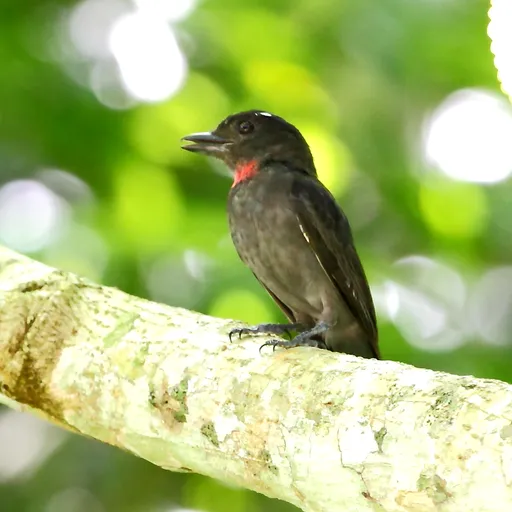
Pink-throated Becard
Pachyramphus minor
Least Concern
Listen
XC249169 · Niels Krabbe · Orellana: 'Maxus' road km 37 (27 km SSE Pompeya), Ecuador · CC BY-SA 4.0
Overview
The pink-throated becard (Pachyramphus minor) is a species of bird in the family Tityridae found throughout the Amazon Basin and the Guiana Shield. It is a year-round resident classified as Least Concern by the IUCN, with a very large range across mainland South America.
Identification
- Adult males are mostly black to dark sooty gray, featuring a distinctive pink patch on the lower throat and upper breast that is sometimes indistinct, with white at the wing bend visible in flight.
- Adult females have a grayish brown crown and nape, a small buff spot above the lores on an otherwise buff face, gray back, rufous wings and tail, and buff underparts.
- Measures 16.5 to 17.5 cm in length and weighs 31 to 44 g, with a bill that is either all black or has a black maxilla and gray mandible, and blackish to gray legs.
- Generally quiet, but songs include a clear, melodic teuuuweeet often followed by twittering notes, a thin, wiry, high, rising-falling whine, or a clear rising whistle; calls consist of rapid chatter of squeaky whistles and a sharp ik.
Habitat
The species inhabits a variety of forested landscapes in the Amazon Basin and the Guiana Shield, with a preference for evergreen terra firme but also found in várzea, swamp, and savanna forests. Its range extends from southeastern Colombia south through eastern Ecuador and eastern Peru into northern Bolivia, and east across southern and eastern Venezuela, the Guianas, and Brazil north of a line from southern Mato Grosso do Sul to the Atlantic in Maranhão.
Diet
The pink-throated becard feeds mostly on insects and fruits, foraging in pairs or small family groups and regularly joining mixed-species feeding flocks. It forages in the forest's mid-story to its canopy, taking food from foliage with sallies from a perch that may include a short hover.
Did you know?
Despite the breeding season not being formally defined, nest-building, nests with eggs, and other signs of breeding have been observed in almost every month of the year in some part of its range. Its nest is a large ball made from leaves and moss with a side entrance, usually situated high in a tree.
Sources
- Wikipedia · CC BY-SA 4.0
- Wikidata · CC0 1.0