
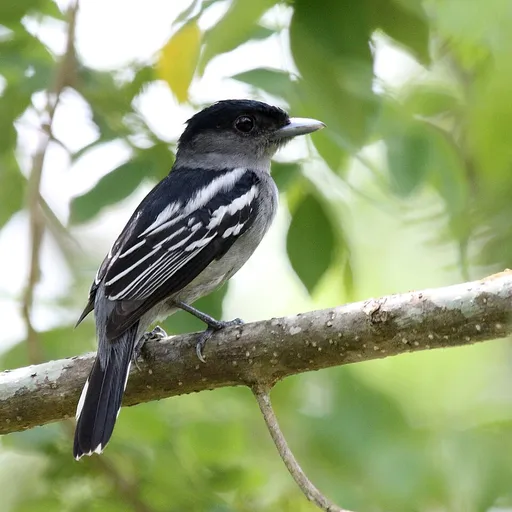
White-winged Becard
Pachyramphus polychopterus
Least Concern
Listen
XC923640 · JUAN ANTONIO ALONSO DE JUAN · Vereda La Máquina, Pacho, Cundinamarca, Colombia · CC BY 4.0
Overview
The white-winged becard (Pachyramphus polychopterus) is a species of bird in the family Tityridae. It is classified as Least Concern by the IUCN due to its extremely large range and stable population of at least five million mature individuals.
Identification
- Adult males feature a glossy black to almost bluish crown and nape, with slate-gray faces and underparts that become paler on the belly.
- Distinctive wide white edges on the wing coverts and secondaries create two prominent wing bars, while the long tail has white tips on all feathers except the central pair.
- Adult females possess brown-olive upperparts, a pale yellowish face with a partial white eye-ring, and wings with wide buff-cinnamon edges.
- The species is 14 to 15.5 cm long, weighing between 19.5 and 21 g, with a dark iris, a blackish or silver-gray bill tipped in black, and dark gray or plumbeous legs.
Habitat
The species inhabits a wide variety of somewhat open landscapes in tropical and lower subtropical zones, including forest edges, clearings, gallery and riparian forests, secondary growth, and shaded plantations. It ranges from sea level up to elevations of 1,500 m, with some local populations reaching 1,900 m in Venezuela. Its distribution covers nearly all of Central America (excluding El Salvador), Trinidad and Tobago, and most of South America (excluding Chile).
Diet
The white-winged becard feeds on large insects such as beetles and leafhoppers, spiders, and considerable amounts of small berries. It typically forages singly or in pairs, but frequently joins mixed-species feeding flocks. Foraging occurs from the mid-story to the canopy, where it gleans food using sallies from perches that may include short hovers.
Did you know?
The far southern population is a seasonal migrant that moves north after the breeding season, occurring in far southeastern Peru only during the austral winter. The species constructs a bulky globe-shaped nest with a side entrance, made from materials such as grass, plant fibers, and Spanish moss, which is wedged in a branch fork and hidden in foliage.
Sources
- Wikipedia · CC BY-SA 4.0
- Wikidata · CC0 1.0