
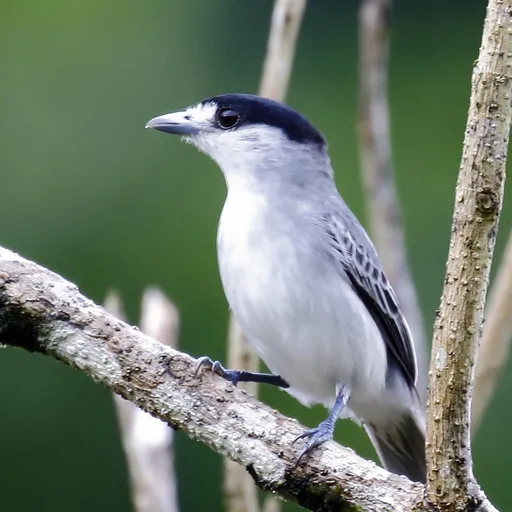
Cinereous Becard
Pachyramphus rufus
Least Concern
Overview
The cinereous becard (Pachyramphus rufus) is a species of bird in the family Tityridae, found across northern South America and the Amazon Basin. It is classified as Least Concern on the IUCN Red List, with an estimated population of at least 500,000 mature individuals, although this population is believed to be decreasing.
Identification
- Adults exhibit sexual dimorphism; males have a glossy black crown, white forehead and lores, and pearl-gray upperparts, while females possess a dark chestnut-rufous crown and bright cinnamon-rufous upperparts.
- The species measures 12.9 to 14 cm in length and weighs approximately 18.5 g, featuring a blackish bill, grayish legs, and a dark iris in both sexes.
- Vocalisations include a fast series of rising musical notes that accelerate into a trill, such as 'twee, twee, twee-twee-twee-tweetweeteeteetititi', alongside calls described as a 'high-pitched and metallic-sounding eeeeé' and a 'buzzy breez-det'.
Habitat
Found from southern Panama across northern South America, including Brazil, Colombia, the Guianas, and Peru, with tentative records in Ecuador. The bird inhabits a wide variety of tropical and lower subtropical forest types, including gallery forest, secondary growth, deciduous woodlands, scrublands, agricultural areas, and coastal mangroves. Elevation ranges vary by location, from sea level to 1,500 m in Colombia, though it reaches 1,500 m in Panama and 1,300 m in Venezuela.
Diet
The cinereous becard feeds mostly on arthropods, supplementing its diet with small fruits and berries. It typically forages singly or in pairs, seldom joining mixed-species feeding flocks, and perches at any level in the forest to glean from vegetation or grab food with an upward sally.
Did you know?
The species' English name reflects its ash-colored appearance, while its specific epithet rufus means 'red' in Latin, referencing the cinnamon-rufous plumage of females and the nominate male's upper back tinge.
Sources
- Wikipedia · CC BY-SA 4.0
- Wikidata · CC0 1.0