
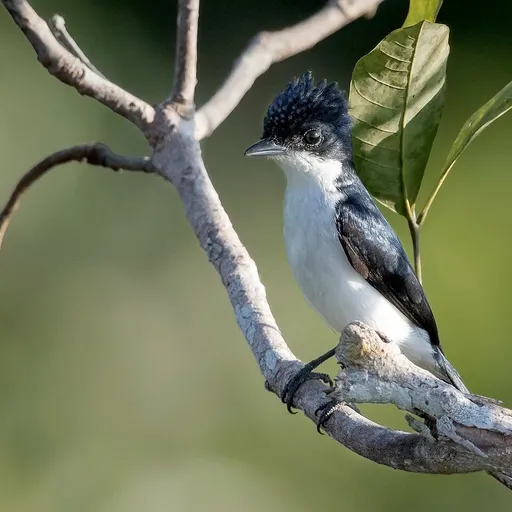
Glossy-backed Becard
Pachyramphus surinamus
Least Concern
Overview
The glossy-backed becard (Pachyramphus surinamus) is a species of bird in the family Tityridae found in northern South America. It is considered a species of Least Concern by the IUCN, though it is described as rare and apparently local within its range.
Identification
- Adults are approximately 13 to 14 cm long, with males being glossy black with a slight bluish sheen and pure white underparts.
- Females feature blackish crowns with chestnut-brown tips, pale gray faces, and white underparts, contrasting with the male's all-dark upper body.
- Both sexes possess a blackish bill, dark legs, and dark irises.
- The song is a very high, sharp 'wuh-wheéé-wuwuweé' where the 'wheéé' is stressed at the end and the 'wu' can be repeated up to six times.
Habitat
This species inhabits the canopy and subcanopy of humid forests, as well as trees in clearings and nearby savanna, ranging in elevation from sea level to 300 m. Its range covers areas north of the Amazon River in Brazil, extending to the Atlantic coast in Suriname, French Guiana, and Brazil's Amapá state, with scattered records in Guyana, Venezuela, and further south in Brazil.
Diet
The glossy-backed becard feeds mostly on insects and includes some fruit in its diet. It usually forages in pairs, though not close together, gleaning food while hopping along branches or making short flights to briefly hover.
Did you know?
The bulky globe nest, constructed from dead leaves, moss, and plant fibers, is typically suspended from a branch between 25 and 30 m above the ground and is usually built near a wasp or bee nest.
Sources
- Wikipedia · CC BY-SA 4.0
- Wikidata · CC0 1.0