
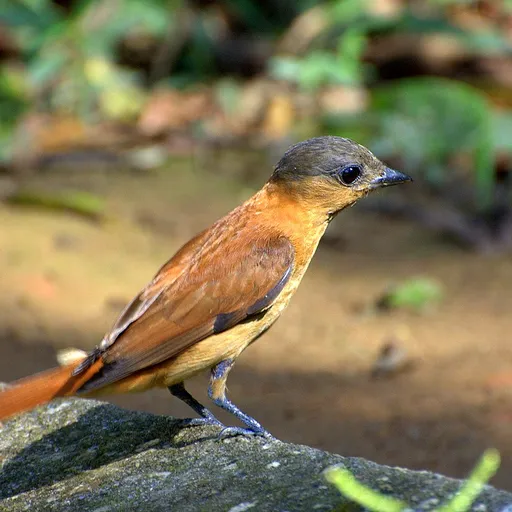
Crested Becard
Pachyramphus validus
Least Concern
Overview
The crested becard, also known as the plain becard, is a species of bird in the family Tityridae. It is found across parts of South America, including Argentina, Bolivia, Brazil, Paraguay, Peru, and possibly Ecuador.
Identification
- Length 17 to 18.5 cm with sexually dimorphic plumage; males are mostly dark grayish to black with a white back patch, while females feature bright rufous upperparts and a rufous nape.
- Possesses a somewhat shaggy crown but lacks an obvious raised crest, along with dark gray legs and feet.
- Vocalisations include unstructured sharp rolling notes, a low descending series of 6–8 dui whistles, or a shrill tsree whistle.
Habitat
Inhabits semi-arid to semi-humid woodlands and montane forest, favouring the forest canopy, edges, and wet ravines. Elevations range from sea level to 2,000 m in Brazil and 1,700 to 3,400 m in Peru. It is generally a year-round resident, though it may occasionally visit far southeastern Peru in the austral winter.
Diet
Feeds mostly on large insects, usually foraging singly but occasionally joining mixed-species feeding flocks.
Did you know?
The nest is a bulky globe constructed from dead leaves and plant fibres that usually hangs from the end of a branch.
Sources
- Wikipedia · CC BY-SA 4.0
- Wikidata · CC0 1.0