
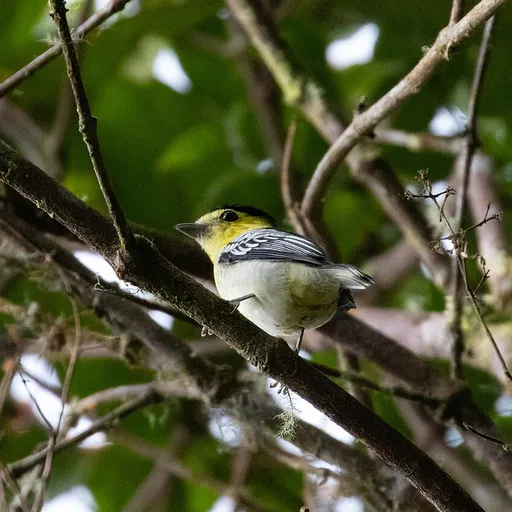
Barred Becard
Pachyramphus versicolor
Least Concern
Listen
XC248528 · Niels Krabbe · Pichincha: turnoff to Mindo, Ecuador · CC BY-SA 4.0
Overview
The barred becard (Pachyramphus versicolor) is a small passerine bird in the family Tityridae. It has a disjunct distribution across Central and South America, with populations found in Costa Rica, Panama, and the Andean regions of Colombia, Venezuela, Ecuador, Peru, and Bolivia.
Identification
- Size: 12 to 13 cm long and weighing 14 to 17 g, making it the smallest member of the genus Pachyramphus.
- Male plumage: Glossy black crown and upperparts with greenish-yellow lores, face, and throat; underparts are white with thin blackish bars; wings are black with white edges.
- Female plumage: Slate gray crown and olive green upperparts; breast is olive, becoming darker on the underparts with fainter dusky bars; rufous wing coverts.
- Song: A rising or rising-falling, accelerating series of thin, high whistles described as "wur wee WEE-WEE’WEE’WEE-WEE", accompanied by thin, squeaky chattered calls.
Habitat
The barred becard inhabits subtropical and lower temperate landscapes, including cloud forest, elfin forest, and humid montane woodlands. It occurs in both somewhat open forest and scrubby ravines, ranging in elevation from 1,100 m to 3,000 m depending on the location.
Diet
It feeds mostly on insects and also includes small fruits in its diet. Foraging takes place primarily in the mid-story to canopy, though it descends to the forest edge; it forages singly, in pairs, or in family groups, and occasionally joins mixed-species feeding flocks.
Did you know?
The bird’s preference for disturbed land for nesting suggests that its population as a whole may have some resistance to the effects of deforestation, despite its estimated population of at least 500,000 mature individuals being believed to be decreasing.
Sources
- Wikipedia · CC BY-SA 4.0
- Wikidata · CC0 1.0