
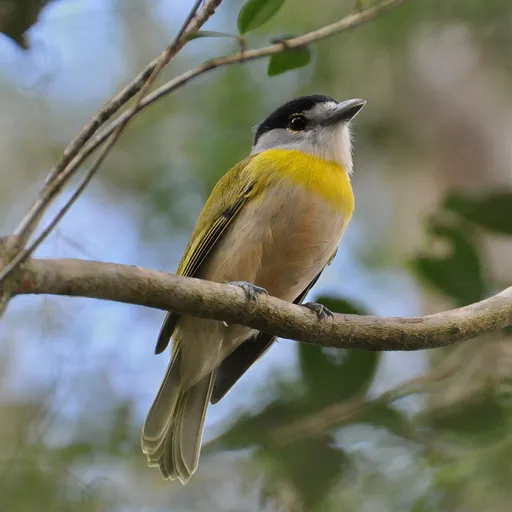
Green-backed Becard
Pachyramphus viridis
Least Concern
Overview
The green-backed becard (Pachyramphus viridis) is a passerine bird in the family Tityridae, commonly known as the tityras and becards. It is found across parts of South America, including Argentina, Bolivia, Brazil, Guyana, Paraguay, Uruguay, and Venezuela.
Identification
- Males display a glossy black crown, whitish lores, and a thin yellowish eye-ring, with pale gray faces and napes.
- Upperparts are bright olive, while the throat is whitish, the breast is bright yellow, and the remaining underparts are grayish white with a buffy tinge.
- Both sexes possess a pale bluish horn bill, a dark iris, and dusky or grayish legs and feet.
- The song consists of an abruptly starting, ascending, and slightly decelerating series of 10-15 'dee-dee---' notes or 'jeh-weeé--' notes.
Habitat
The species primarily inhabits humid to moist forest in tropical and lower montane zones, favouring broken and somewhat open areas, riparian forests, and terra firme forests. It has a disjunct distribution, with the nominate subspecies ranging from eastern and southern Brazil through Paraguay into northeastern Argentina and northern Uruguay, while other subspecies occupy parts of Venezuela, Guyana, Ecuador, and Peru.
Diet
Although not fully studied, the diet is believed to consist mostly of insects with some fruit. The bird forages at any level of the forest, typically taking food by reaching from a perch, snatching it after a short flight, or while briefly hovering.
Did you know?
The female is solely responsible for incubating the clutch for approximately 18 to 21 days, after which both parents provision the nestlings.
Sources
- Wikipedia · CC BY-SA 4.0
- Wikidata · CC0 1.0