
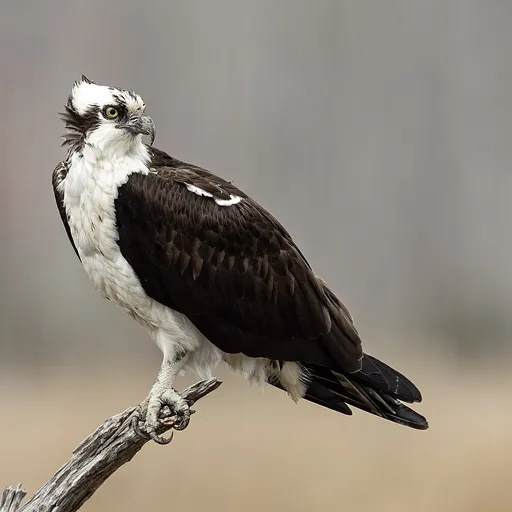
Osprey
Pandion haliaetus
Least Concern
Listen
XC1169889 · Pascal Christe · Switzerland · CC BY-SA 4.0
Overview
The osprey (Pandion haliaetus) is a diurnal, fish-eating bird of prey with a cosmopolitan range. It is the sole living member of the family Pandionidae and is classified as a species of Least Concern on the IUCN Red List.
Identification
- Upperparts are deep, glossy brown, while the head is white with a dark mask extending to the sides of the neck; underparts are pure white or the breast may be streaked with brown.
- In flight, the bird displays arched wings and drooping 'hands', giving it a gull-like appearance, with black wrists visible on the underside of the wings.
- A large raptor measuring 50–66 cm in length with a 127–180 cm wingspan; features reversible outer toes and white feet with black talons.
- Call consists of a series of sharp whistles described as cheep, cheep or yewk, yewk, which may become a frenzied cheereek if the nest is disturbed.
Habitat
The osprey is found in temperate and tropical regions of all continents except Antarctica, living in a wide variety of habitats. It typically nests in locations near a body of water that provides an adequate food supply, such as freshwater lakes, rivers, or coastal brackish waters.
Diet
The species is piscivorous, with fish making up 99% of its diet, usually taking live fish weighing 150–300 g. It detects underwater prey from 10–40 m above the surface, hovers momentarily, and then plunges feet first into the water, often completely submerging its body.
Did you know?
The osprey and owls are the only raptors whose outer toes are reversible, allowing them to grasp slippery prey with two toes in front and two behind. The common name 'osprey' may be derived from the Latin ossifraga, meaning 'bone breaker', though this term originally referred to the bearded vulture.
Sources
- Wikipedia · CC BY-SA 4.0
- Wikidata · CC0 1.0