
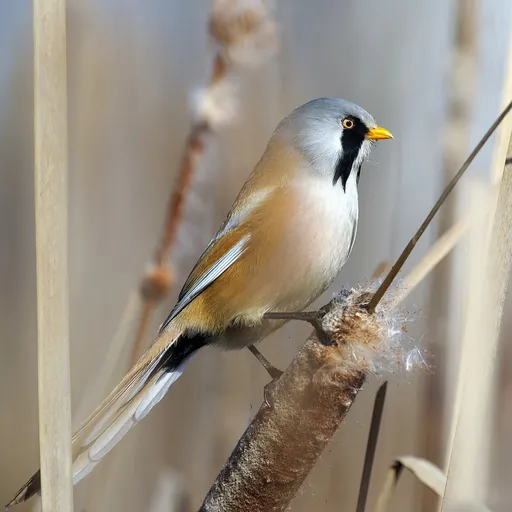
Bearded Reedling
Panurus biarmicus
Least Concern
Listen
XC730824 · Sonothèque ADVL · Genêts, Manche, Normandie, France · CC0 1.0
Overview
The bearded reedling (Panurus biarmicus) is a small, long-tailed passerine bird that resides in reed beds near water across the temperate zones of Eurasia. It is a unique species with no close relatives, constituting the only member of the family Panuridae. Previously associated with tits or parrotbills, it is now recognised as a distinct lineage nearest to the lark family.
Identification
- A small bird measuring 14.5–17 cm in length with a long tail and an undulating flight.
- Plumage is primarily orange-brown with a whitish throat and chest; adult males possess a grey head, black 'moustaches', and black undertail coverts, while females are generally paler without these black markings.
- Characterised by a metallic 'ping' call used for contact and a male song described as a tuneful 'tschin-schik-schra'.
- Juveniles resemble adult females but feature a roughly rectangular black patch on the back and extensive black on the tail feathers.
Habitat
Native to temperate Europe and Asia, ranging from Spain and the British Isles to the Manchurian region, though its distribution is often spotty due to specific habitat needs. It is a specialist of reed beds, particularly those with common reed, situated by fresh or brackish water lakes, swamps, or rivers, and may also utilise nearby tall grasses. The species is generally resident, though some populations in northern Europe may move short distances south or southwest during the non-breeding season.
Diet
In summer, it primarily consumes small invertebrates such as adult insects, larvae, and pupae, favouring slow-moving species. During late autumn and winter, it shifts to feeding on seeds from common reed, rushes, and other grassy plants, sometimes forming mixed flocks with other seed-eaters. To digest these tough seeds, the bird swallows gritting materials like coarse sand or gravel between September and December, and its stomach lining strengthens to cope with the dietary change.
Did you know?
Bearded reedlings possess a relatively large and muscular cloacal protuberance that functions as a copulatory organ, a trait that is unique among passerines. They are also highly productive, potentially raising the highest number of young in a season of any European passerine.
Sources
- Wikipedia · CC BY-SA 4.0
- Wikidata · CC0 1.0