
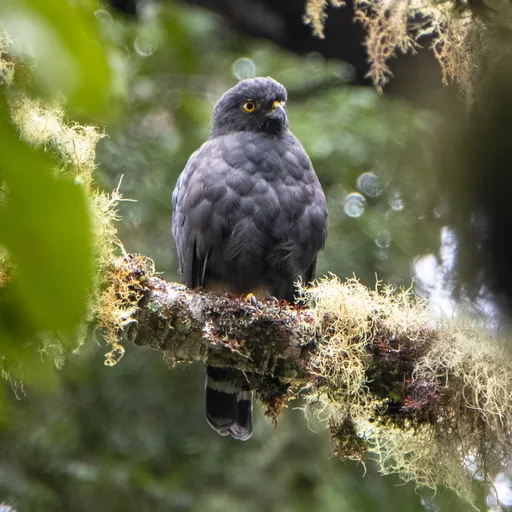
White-rumped Hawk
Parabuteo leucorrhous
Least Concern
Listen
XC251305 · Niels Krabbe · Zamora-Chinchipe: Reserva Tapichalaca, Ecuador · CC BY-SA 4.0
Overview
The white-rumped hawk (Parabuteo leucorrhous) is a species of bird of prey belonging to the subfamily Accipitrinae within the family Accipitridae. It is classified as Least Concern on the IUCN Red List, though its population is believed to be decreasing despite a large range.
Identification
- Adults are almost entirely black with a distinctive white rump and undertail coverts, while immatures display brown upperparts with rufous mottling and heavily mottled rufous underparts.
- A medium-sized raptor measuring 33 to 40 cm in length with a 67 to 79 cm wingspan, featuring yellow eyes, cere, legs, and feet.
- The tail bears a narrow grayish-brown band at its midpoint, and the thighs are feathered rufous.
- Vocalisations include a high-pitched whistle with variations described as "KEEEEiu" and a longer, more monotonous high-pitched whistle.
Habitat
Found in Argentina, Bolivia, Brazil, Colombia, Ecuador, Paraguay, Peru, and Venezuela, the species inhabits the interior and edges of dense subtropical and tropical forests as well as the Chaco in the east. It primarily occupies elevations between 1,500 and 3,500 m in its western Andean range but occurs at lower elevations in the eastern range.
Diet
The specific hunting methods and diet of the white-rumped hawk are mostly unknown, though it has been documented feeding on reptiles, frogs, insects, and rats.
Did you know?
A single described nest was constructed as a shallow cup of sticks lined with green leaves, situated a remarkable 22 m (72 ft) above the ground in a pine tree.
Sources
- Wikipedia · CC BY-SA 4.0
- Wikidata · CC0 1.0