
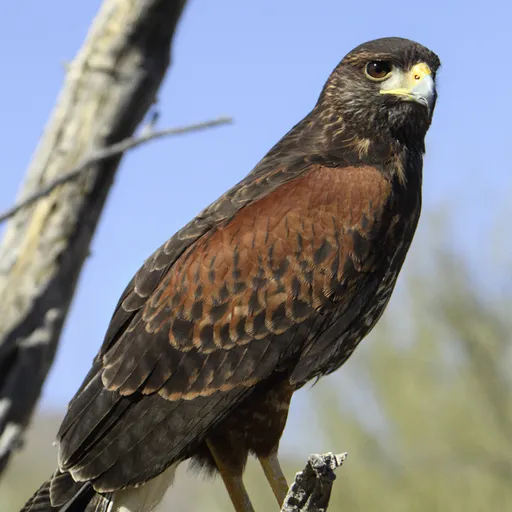
Harris's Hawk
Parabuteo unicinctus
Least Concern
Overview
The Harris's hawk (Parabuteo unicinctus) is a medium-large bird of prey that breeds from the southwestern United States south to Chile, central Argentina, and Brazil. It is notable for its social nature, hunting cooperatively in packs rather than alone, a trait that makes it an easy bird to train and a popular choice for falconry.
Identification
- Roughly intermediate in size between a peregrine falcon and a red-tailed hawk, with females larger by about 35%.
- Dark brown plumage with chestnut shoulders, wing linings, and thighs, and a white band at both the base and tip of the tail.
- Long, yellow legs and a yellow cere.
- Vocalisations are very harsh sounds.
Habitat
Harris's hawks inhabit sparse woodland, semi-desert, and marshes with trees, including mangrove swamps in parts of their South American range. They are permanent residents that do not migrate, using scattered larger trees, utility poles, and boulders as important perches and nest supports.
Diet
The majority of their diet consists of mammals such as ground squirrels, rabbits, and black-tailed jackrabbits, though they also take birds ranging from small passerines to large herons, as well as reptiles and insects. They forage cooperatively in groups of two to six, using strategies that involve scouting or flushing prey to take advantage of their fast running ability on the ground.
Did you know?
Harris's hawks are the only raptors known to hunt in groups as routinely, a behaviour attributed to their intelligence and the scarcity of prey in their desert habitats. Their cooperative nature has made them the most popular hawks in the West outside of Asia for falconry since the 1980s.
Sources
- Wikipedia · CC BY-SA 4.0
- Wikidata · CC0 1.0