
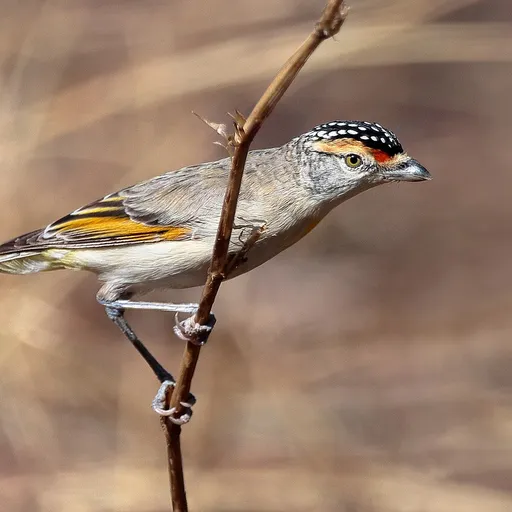
Red-browed Pardalote
Pardalotus rubricatus
Least Concern
Overview
The red-browed pardalote (Pardalotus rubricatus) is a small, brightly coloured insectivorous passerine bird endemic to Australia. It belongs to the family Pardalotidae and is considered a species of least concern by the IUCN, with a stable population throughout its range.
Identification
- Adults average 105 mm in length with a wingspan of 60–66 mm, though the yorki subspecies is smaller at 100–120 mm.
- The nominate race features a black crown with distinctive white spots, a red to orange-red brow, a pale iris, and a yellow breast patch with yellow wing panels.
- The yorki subspecies is more brightly coloured, possessing a straw-brown or yellow iris, fine dark scalloping on the mantle, a bright yellow breast and rump, and orange wing panels.
- The call consists of a distinctive five or six-note song where the first note is longer and lower-pitched, followed by notes that increase in pitch and speed, sounding similar to a rosella.
Habitat
The species is widely distributed across north and central Australia, extending to south and south-central Western Australia, northeast South Australia, and southwest New South Wales, including the Great Sandy, Gibson, and Great Victoria Deserts. It inhabits a variety of environments such as woodlands, shrublands, and tropical, arid, and semi-arid regions, with a preference for eucalypt woodlands bordering watercourses, riparian river red gums, coolibah woodlands, and mallee shrublands.
Diet
As a gleaning specialist, the red-browed pardalote uses its 'scoop-shaped' bill to forage for insects and lerps (psyllid exudates) on eucalypt leaf surfaces, with lerps providing a major source of sugar and carbohydrates. The diet also includes various arthropods such as beetles, flies, mosquitoes, leafhoppers, shield bugs, bees, and ants, as well as vegetable matter.
Did you know?
Although primarily excavating tunnels in sandy banks, gullies, and sand dunes, the species has been recorded nesting halfway down an iron pipe set upright in the ground. They also sometimes utilise the existing burrows of mammals such as kangaroo rats, hopping mice, and bilbies for nesting.
Sources
- Wikipedia · CC BY-SA 4.0
- Wikidata · CC0 1.0