
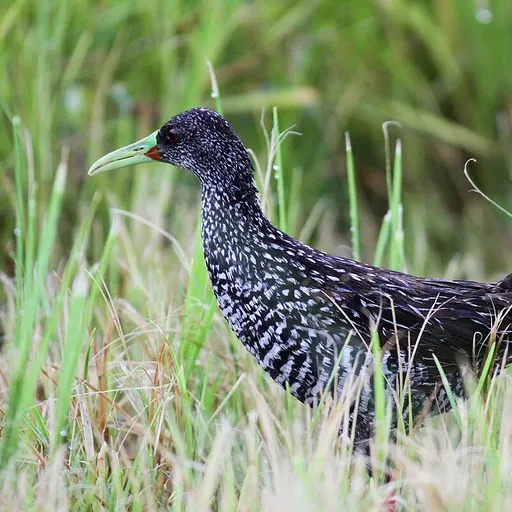
Spotted Rail
Pardirallus maculatus
Least Concern
Listen
XC251307 · Niels Krabbe · Manabí: La Segua marsh (Chone lakes), Ecuador · CC BY-SA 4.0
Overview
The spotted rail (Pardirallus maculatus) is a bird in the rail, crake, and coot family Rallidae, native to the Americas. Classified as Least Concern by the IUCN, it is distributed across Mexico, Central America, the Caribbean, and South America.
Identification
- Males and females are alike, measuring 25 to 28 cm in length and weighing between 130 and 220 g, with females being slightly smaller.
- Adults have a blackish head with a red eye, black and brown upperparts, and black underparts featuring white streaks and spots; the nominate subspecies displays white streaks on the upperparts, while the insolitus subspecies has white spots.
- The bill is long and greenish with a distinct red spot at the base of the mandible, accompanied by pinkish legs.
- Vocalisations include a loud, rasping, groaning screech resembling a 'g'reech' or 'pum-kreep', along with deep thumping sounds and reedy chatters such as 'tchi-di-dert'.
Habitat
The species inhabits wet landscapes, including marshes, swamps, rice fields, and wet grasslands, where it requires dense cover. Its range spans from Mexico to South America, though its distribution in Mexico, Central America, and much of South America is local rather than continuous.
Diet
The spotted rail forages in shallow water or along the water's edge, typically remaining in cover except at dawn and dusk when it may feed in more open areas. Its diet consists of earthworms, adult and larval insects, other invertebrates, small fish, and pondweed.
Did you know?
Despite being a bird, spotted rails have been observed in captivity climbing up vegetation by using their wings for balance before flying back down. They can also become vulnerable to predation by invasive species like the mongoose when they moult most of their flight feathers simultaneously.
Sources
- Wikipedia · CC BY-SA 4.0
- Wikidata · CC0 1.0