
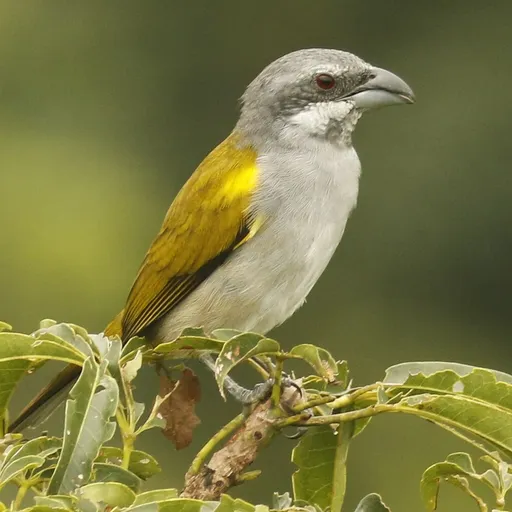
Yellow-shouldered Grosbeak
Parkerthraustes humeralis
Least Concern
Overview
The yellow-shouldered grosbeak (Parkerthraustes humeralis) is a species of bird in the tanager family Thraupidae. It is the only member of its genus and is classified as Least Concern by the IUCN, though its population is believed to be decreasing.
Identification
- A medium-sized bird measuring 16 to 16.5 cm, with a bill that is less massive than that of other grosbeaks.
- Plumage features a slate gray crown and nape, a wide black mask, olive-green upperparts, and distinctive yellow secondary wing coverts.
- The throat is white with black scaling or barring, while the breast and belly are gray and the vent and undertail coverts are yellow.
- Possesses a red iris, a black maxilla with a gray mandible, and gray legs; the song is a repetitive high, lisping 'seet tseer-tseer'.
Habitat
This species inhabits humid terra firme forest in the western and southern Amazon Basin, primarily within the canopy. Its range extends from southwestern Colombia south through eastern Ecuador and Peru into Bolivia, and eastward across Brazil south of the Amazon. It occurs at elevations generally below 1,000 m, though specific limits vary by country.
Diet
The diet includes insects, seeds, and flowers, with most insect food taken by gleaning from foliage. It usually forages in pairs high in the canopy as part of a mixed-species feeding flock.
Did you know?
The species was moved to its own genus, Parkerthraustes, in 1997 to honour the late ornithologist Theodore A. Parker III. Its breeding biology remains completely unknown, and its song is rarely heard in the field.
Sources
- Wikipedia · CC BY-SA 4.0
- Wikidata · CC0 1.0