
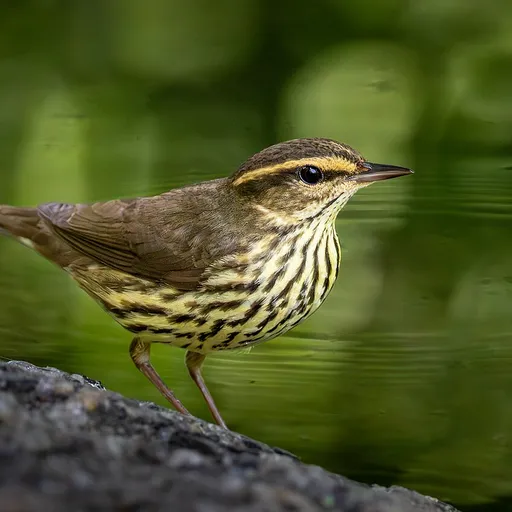
Northern Waterthrush
Parkesia noveboracensis
Least Concern
Listen
XC841155 · Rosa Elena Albornoz · Chacao (near Caracas), Chacao, Miranda, Venezuela · CC0 1.0
Overview
The northern waterthrush (Parkesia noveboracensis) is a large New World warbler that feeds on the ground rather than in trees, despite its name suggesting otherwise. This migratory species breeds across the northern parts of North America and winters in warmer regions such as Florida, Central America, and parts of South America.
Identification
- A large warbler measuring 12–15 cm in length, with an evenly brown back and a brown crown featuring a white supercilium.
- The throat is lightly streaked brown to black, with heavier streaking continuing onto the breast and flanks, while young birds possess buff underparts instead of white ones.
- It has a pointed, dark bill and walks with a distinctive teetering motion, bobbing its rear end as it moves along the ground.
- The song consists of loud, emphatic, clear chirping notes that generally fall in pitch and accelerate, often appearing loosely paired or tripled.
Habitat
Breeding territories are found in wet woodlands near water, especially along rivers and streams, though the species may occasionally nest in upland areas among the roots of fallen trees. During the winter in places like Puerto Rico, they inhabit white, red, and black mangroves as well as scrub, with males preferring white mangrove areas to maintain weight. The species is also known as a rare vagrant to western Europe and parts of South America.
Diet
As a terrestrial ground feeder, it consumes insects, spiders, mollusks such as snails, worms, and crustaceans found amongst leaf litter, alongside minnows located by wading through water. On wintering grounds in mangroves, the ability to maintain body weight depends on habitat type and moisture levels, with scrub habitats being less supportive for weight gain.
Did you know?
Despite the common name, this bird is not a thrush but a large New World warbler. Males and females exhibit different wintering strategies in Puerto Rico, with larger, earlier-migrating males favouring the food-rich white mangrove while females utilise drier, less food-rich habitats such as scrub.
Sources
- Wikipedia · CC BY-SA 4.0
- Wikidata · CC0 1.0