
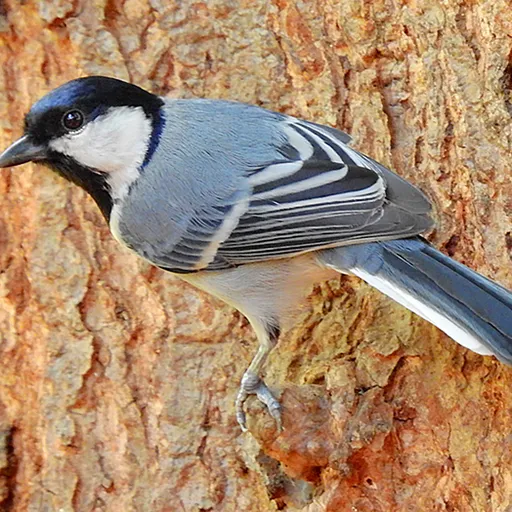
Cinereous Tit
Parus cinereus
Listen
XC662878 · Vihansith Kulatunga · Watapuluwa, Kandy, Sri Lanka, Sri Lanka · CC BY-SA 4.0
Overview
The cinereous tit (Parus cinereus) is a small passerine bird in the family Paridae that was formerly considered a subspecies of the great tit. It comprises multiple populations across Asia, including the Japanese tit, which was previously treated as a separate species. This species is distinct from the great tit by its grey back and white underparts, in contrast to the greenish back and yellowish underside of Parus major.
Identification
- Grey-backed plumage with a broad black ventral stripe and white cheek patches.
- Black hood and white wing-bar; no crest.
- Whistling call described as 'titiweesi...titiweesi... witsi-seesee', often repeated three or four times.
- Females possess a narrower ventral line and slightly duller plumage than males.
Habitat
The distribution of this species spans from West Asia across South Asia into Southeast Asia, encompassing regions such as Japan, Korea, India, and the Malay Peninsula. Nests are typically constructed in hollows in trees, walls, or mud-banks, and may reuse cavities left by woodpeckers or barbets.
Diet
Foraging is primarily done by gleaning insects such as caterpillars, bugs, and beetles, often within mixed-species flocks. The bird may also consume buds and fruits, and has been observed using its feet to hold insects while tearing them with its beak, or by wedging hard seeds in bark crevices to hammer them.
Did you know?
Research indicates that the vocalisations of Parus cinereus encode specific messages like 'scan surroundings' or 'approach', with the order of these calls exhibiting a structure comparable to syntax and grammar in human language. Furthermore, the birds demonstrate the cognitive ability to create mental images for calls that signal the presence of a snake, a trait previously thought to be unique to humans.