
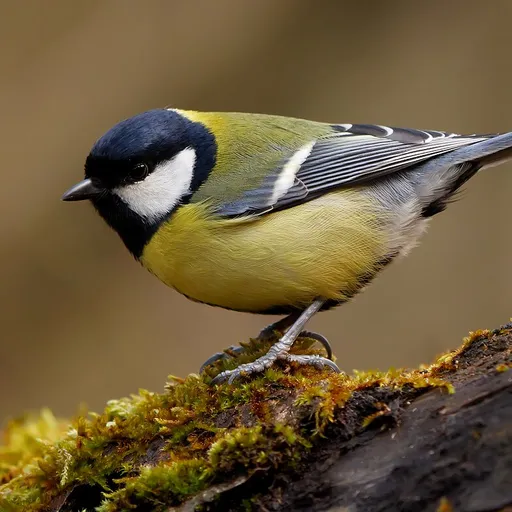
Great Tit
Parus major
Least Concern
Listen
XC1169119 · Philippe Grange · Arrondissement de la Roche-sur-Yon (near La Roche-sur-Yon), Vendée, Pays de la Loire, France · CC0 1.0
Overview
The great tit (Parus major) is a small passerine bird in the tit family that is widespread and common throughout Europe, the Middle East, and Central Asia. It is a highly adaptable species that has thrived in human-altered environments, becoming a familiar presence in urban parks and gardens. This species is listed as Least Concern by the IUCN and remains the most widespread species within the genus Parus.
Identification
- Length of 12.5 to 14 cm with a distinctive appearance featuring a black head and neck and prominent white cheeks.
- Bright lemon-yellow breast with a broad black mid-line stripe running to the vent, set against olive or greenish upperparts.
- Loud vocalisations include a familiar 'teacher, teacher' call likened to a squeaky wheelbarrow wheel, along with a sharp 'tink' used for alarms.
Habitat
The great tit occupies a variety of habitats, most commonly open deciduous woodland, mixed forests, forest edges, and gardens, where it often uses tree holes for nesting. In North Africa, it resides in oak forests and palm groves, while in eastern ranges it favours riverine willow and birch forests. The species is generally resident, remaining in its territory year-round except in extremely harsh winters when irruptions may occur.
Diet
Primarily insectivorous in the summer, the bird captures insects and spiders by foliage gleaning, including prey such as caterpillars, which are fed to nestlings for protein. In autumn and winter, the diet expands to include berries and seeds from deciduous trees, and the birds frequently visit bird tables for peanuts and sunflower seeds. In severe winters, great tits may consume up to 44% of their body weight in sunflower seeds.
Did you know?
The intensity of the yellow colour on a male's breast correlates with stronger sperm, as higher levels of carotenoids obtained from food enable the sperm to withstand free radicals better. Additionally, female birds select mates partly based on the width of the male's ventral stripe, with higher-quality females preferring males with wider stripes.
Sources
- Wikipedia · CC BY-SA 4.0
- Wikidata · CC0 1.0