
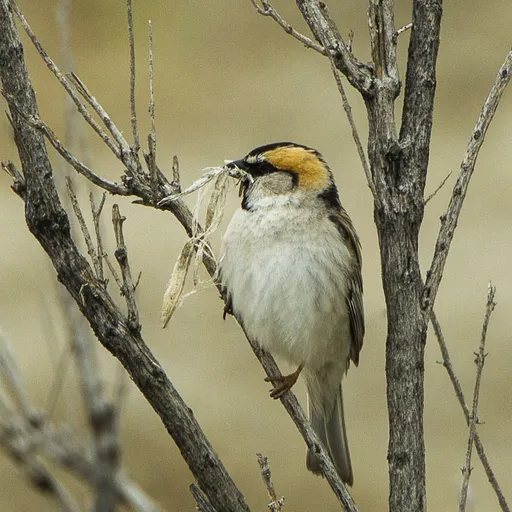
Saxaul Sparrow
Passer ammodendri
Least Concern
Overview
The saxaul sparrow (Passer ammodendri) is a passerine bird of the sparrow family native to parts of Central Asia. At 14–16 centimetres in length, it is among the larger members of its family and is assessed as Least Concern on the IUCN Red List.
Identification
- Plumage ranges from dull grey to sandy brown, with males displaying bold black head stripes and a bib, while females are paler and duller with less distinct markings.
- Pale or pinkish brown legs and a bill that varies in colour from pale grey in juveniles to black in breeding males.
- Distinctive head markings make the bird unlikely to be confused with any other species in its range.
- Vocalisations include a soft, musical chirping call and a pleasantly melodious song.
Habitat
Found in remote desert areas of Central Asia, from central Turkmenistan to northern Gansu in China, the species favours habitats with shrubs such as saxaul, poplar, or tamarisk near rivers and oases. Its distribution comprises six probably disjunct areas, and it may occur around settlements and grain fields during the winter.
Diet
The saxaul sparrow forages in trees and on the ground, feeding mostly on seeds, particularly those of the saxaul plant. Insects, including weevils, grasshoppers, and caterpillars, form a significant part of the diet during the breeding season and for nestlings.
Did you know?
Unusually for a sparrow, the species has not been recorded nesting openly in branches, likely due to the lack of published records, instead preferring cavities in trees, earth banks, and even the nests of birds of prey. It also forms wandering flocks of up to fifty birds when not breeding, associating with house and Eurasian tree sparrows.
Sources
- Wikipedia · CC BY-SA 4.0
- Wikidata · CC0 1.0