
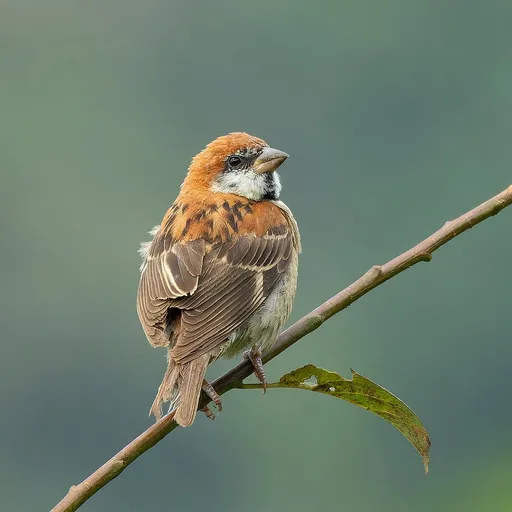
Russet Sparrow
Passer cinnamomeus
Least Concern
Overview
The russet sparrow (Passer cinnamomeus), also known as the cinnamon tree sparrow, is a passerine bird within the sparrow family Passeridae. It is a small, chunky species found across parts of eastern Asia and the Himalayas, classified as Least Concern on the IUCN Red List.
Identification
- Warm rufous plumage above with grey or yellow-tinged underparts; breeding males feature a black bib and thin white supercilium.
- A medium-sized sparrow measuring 14 to 15 cm in body length, with a thick bill that is black in breeding males but horn-coloured in non-breeding males.
- Vocalisations are described as the sweetest and most musical of any sparrow, consisting of monosyllabic cheeps and short, strident songs.
Habitat
Found in eastern Asia and the Himalayas, the russet sparrow typically prefers light woodland in eastern Asia but is strongly associated with terrace cultivation in the Himalayas. It occupies a wide altitudinal range, breeding by the sea in the northernmost parts of its range but staying above 2,500 metres in the south. In urban areas, it often occupies gardens and less built-up spaces, or streets where it is the only sparrow present.
Diet
Primarily a seed-eater, it consumes the seeds of herbs, weeds, and grains such as rice and barley, as well as available berries. During the breeding season, adults and nestlings eat insects, particularly caterpillars and larval beetles obtained from trees or by aerial pursuit. Flocking individuals feed on the ground using a 'roller feeding' technique, moving forward as birds from the rear advance to the front.
Did you know?
The russet sparrow is known to exploit the territorial defence of black kites by nesting in their old nests, thereby avoiding nest predation. It has also been recorded attempting to oust pairs of black-crested tits from their nesting cavities.
Sources
- Wikipedia · CC BY-SA 4.0
- Wikidata · CC0 1.0