
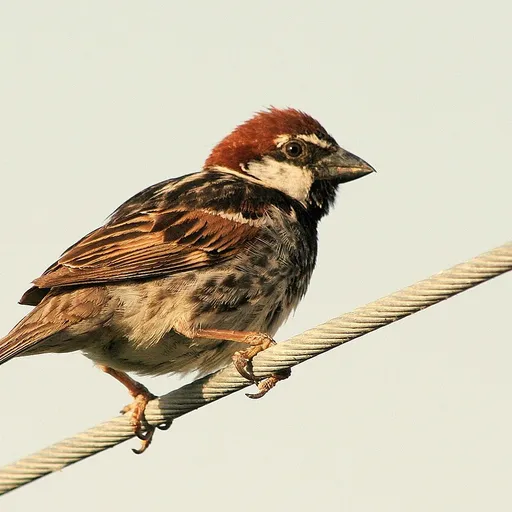
Spanish Sparrow
Passer hispaniolensis
Least Concern
Listen
XC1143446 · Tanguy Loïs · Cáceres (near Sierra de Fuentes), Cáceres, Extremadura, Spain · CC BY-SA 4.0
Overview
The Spanish sparrow, also known as the willow sparrow, is a passerine bird of the family Passeridae that is very similar to the closely related house sparrow. It is found in the Mediterranean region, Macaronesia, and south-west to central Asia, where it often hybridises with house sparrows, complicating its taxonomy.
Identification
- A rather large sparrow, measuring 15–16 cm in length and weighing 22–36 g, it is slightly larger and heavier than house sparrows with a longer, stouter bill.
- Males resemble house sparrows but feature heavily black-streaked underparts, a chestnut crown instead of grey, and white cheeks rather than grey.
- Females are grey-brown and more boldly marked than house sparrows, displaying light streaking on the sides, a pale cream supercilium, and broad cream streaks on the back.
- The male's display call consists of loud, high-pitched, disyllabic chirps transcribed as chweeng-chweeng or cheela-cheeli, distinct from the house sparrow's call.
Habitat
The species breeds in a band roughly 15 degrees wide, spanning from the Danube Valley and Aral Sea to Libya and central Iran. It typically inhabits farmland and open woodland, preferring moister environments than the house sparrow, but may utilise urban habitats where house sparrows are absent, as seen in the Canary Islands and Madeira.
Diet
The Spanish sparrow feeds principally on the seeds of grains and grasses, also consuming leaves, fruits, and other plant materials. During the breeding season, it consumes insects, with nestlings being fed almost exclusively on insects for their first few days. In Central Asia, its insect diet includes caterpillars, ants, grasshoppers, and crickets, while migrating flocks feed mostly on crops in cultivated areas.
Did you know?
A study indicates that vagrant Spanish sparrows tend to occur much closer to railway lines than other vagrant passerines, suggesting that their long-distance expansion may be facilitated by travel on cargo trains.
Sources
- Wikipedia · CC BY-SA 4.0
- Wikidata · CC0 1.0