
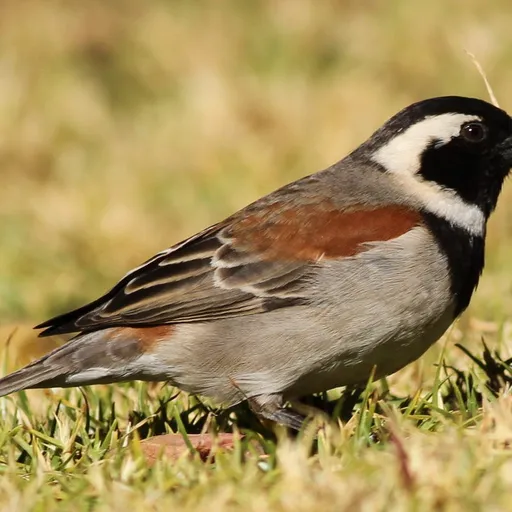
Cape Sparrow
Passer melanurus
Least Concern
Overview
The Cape sparrow (Passer melanurus), also known as the mossie, is a medium-sized member of the sparrow family found throughout southern Africa. It is a common and familiar bird that thrives in semi-arid savannahs, cultivated lands, and urban areas. Classified as a species of least concern, it successfully coexists with other sparrow species in human habitations.
Identification
- A medium-sized bird measuring 14–16 cm in length, with plumage that is mostly grey, brown, and chestnut.
- The breeding male features a mostly black head with broad white markings curving from behind the eye to the throat, connected by a narrow black band to a black breast bib.
- Females resemble males but are duller with a grey head, while juveniles look like females but develop black head markings early.
- Vocalisations are musical and mellow, with basic calls transcribed as 'chissip' or 'chirrup' and a distinctive male advertisement call described as 'tweeng' or 'twileeng'.
Habitat
Native to southern Africa, its range extends from the central coast of Angola to eastern South Africa and Eswatini. The species prefers habitats with annual rainfall below 75 cm, inhabiting semi-arid savannah, thornveld, light woodland, and cultivated areas. In urban environments, it favours open spaces such as parks and gardens rather than densely built-up areas.
Diet
Cape sparrows primarily feed on seeds, particularly larger varieties from cereals, wild grasses, and plants like khakiweed, often foraging in trees and on the ground. They also consume buds, soft fruits, and insects, with nestlings being fed exclusively on caterpillars. Their foraging behaviour can cause significant damage to agriculture, especially in grain fields and vineyards.
Did you know?
The Cape sparrow featured on the lowest-denomination South African coin from 1923 until 2002, a choice inspired by a biblical motto adopted by women interned at a concentration camp during the Boer War. In Johannesburg, these birds exhibit an unusual social behaviour where groups stand close together on the ground with their tails down and heads held high, often hovering silently in unison without any known significance.
Sources
- Wikipedia · CC BY-SA 4.0
- Wikidata · CC0 1.0