
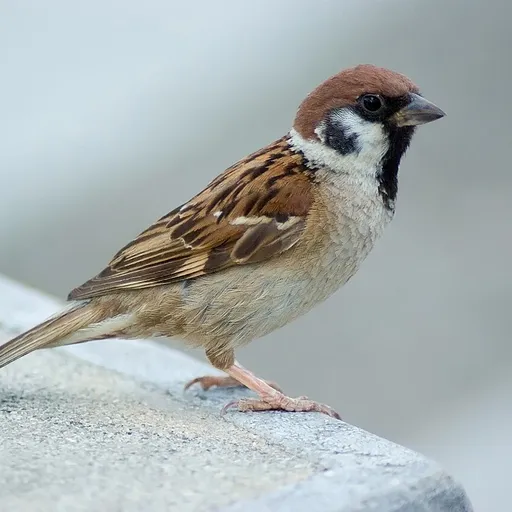
Eurasian Tree Sparrow
Passer montanus
Least Concern
Listen
XC1143702 · Philippe_Grange · Arrondissement of Bressuire (near Saint-André-sur-Sèvre), Deux-Sèvres, Nouvelle-Aquitaine, France · CC0 1.0
Overview
The tree sparrow (Passer montanus) is a passerine bird in the sparrow family, widely distributed across temperate Eurasia and Southeast Asia. It is characterised by a rich chestnut crown, a black ear patch on a white cheek, and a black throat. The species is classified as Least Concern on the IUCN Red List, although significant population declines have occurred in Western Europe.
Identification
- Size: 12.5–14 cm long with a wingspan of about 21 cm, roughly 10% smaller than the house sparrow.
- Plumage: Rich chestnut crown and nape, pure white cheeks with kidney-shaped black ear patches, and a black chin and throat. Upperparts are light brown with black streaking and two distinct narrow white wing bars.
- Bill and Legs: Bill is lead-blue in summer, becoming almost black in winter; legs are pale brown.
- Vocalisations: Lacks a true song, using excited tschip calls, monosyllabic chirps, and a harsh teck flight call.
Habitat
The species breeds across much of temperate Eurasia and Southeast Asia, extending south to Java and Bali. In Europe, it inhabits lightly wooded open countryside, coasts with cliffs, and empty buildings, showing a strong preference for nest sites near wetland habitats. In contrast, it is a widespread urban bird in eastern Asia and Australia, where it often nests in man-made structures.
Diet
The tree sparrow predominantly feeds on seeds and grains, foraging on the ground in flocks alongside other birds like house sparrows and finches. During the breeding season, it consumes invertebrates such as insects, woodlice, and spiders to feed its young, utilising various wetlands to gather this animal prey.
Did you know?
The scientific name montanus suggests a mountain species, but the bird is not typically found in high altitudes, reaching only 700 m in Switzerland despite breeding as high as 4,270 m in Nepal. Its common name is also a misnomer, as it prefers tree holes for nesting rather than being a species of the trees themselves.
Sources
- Wikipedia · CC BY-SA 4.0
- Wikidata · CC0 1.0