
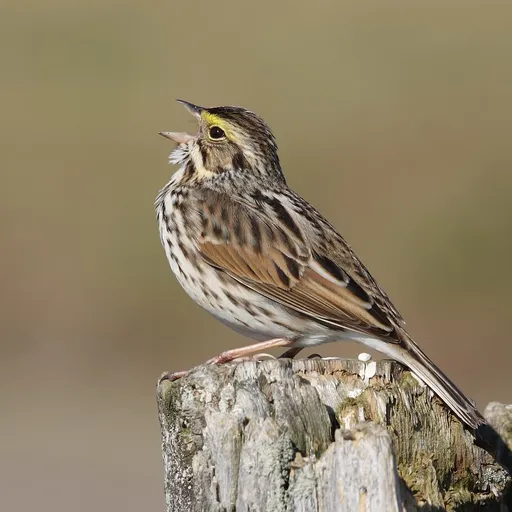
Savannah Sparrow
Passerculus sandwichensis
Least Concern
Listen
XC613094 · Doug Hynes · South River, Newfoundland and Labrador, Canada · CC BY-SA 4.0
Overview
The Savannah sparrow (Passerculus sandwichensis) is a small New World sparrow and the sole member of the genus Passerculus. It is a widespread and abundant species that occupies open grassland habitats across North America, with some populations in Mexico and Central America.
Identification
- Dark-streaked brown back with whitish underparts featuring brown or blackish breast and flank streaking.
- Whitish crown and supercilium stripes, often with some yellow near the beak, contrasting with brown cheeks and a white throat.
- Size varies by subspecies, ranging from 11 to 17 cm in total length, with horn-colored feet and legs and a bill that is dark grey on top and horn-colored below.
- Song is described as a mixture of chirps and trills, with a thin 'seep' flight call.
Habitat
The species inhabits open grasslands, breeding in Alaska, Canada, the northern and central United States, and parts of Mexico and Guatemala. Over most of its range, it is migratory, wintering in the southern United States, Central America, and the Caribbean, though Pacific and Mexican breeders are resident.
Diet
These birds forage on the ground or in low bushes, using grazed low-growth grassland particularly in winter. Their diet mainly consists of seeds, though they also consume insects during the breeding season.
Did you know?
The Ipswich sparrow, a subspecies that breeds on Sable Island, frequently raises three broods in a single year, whereas most other populations raise fewer.
Sources
- Wikipedia · CC BY-SA 4.0
- Wikidata · CC0 1.0