
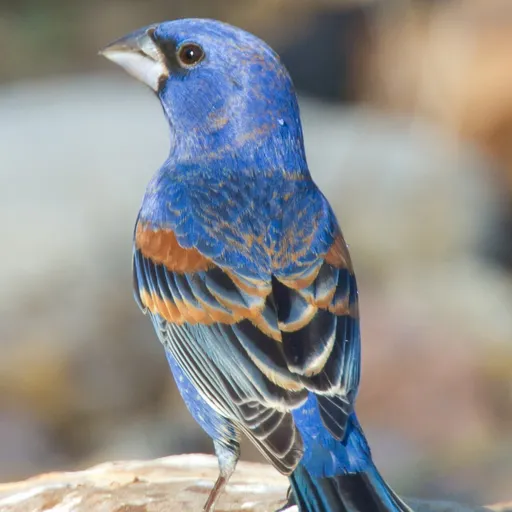
Blue Grosbeak
Passerina caerulea
Least Concern
Listen
XC586018 · Friends of the Pawnee National Grassland · Nunn, Weld County, Colorado, United States · CC0 1.0
Overview
The blue grosbeak (Passerina caerulea) is a medium-sized North American passerine bird in the cardinal family Cardinalidae. It is a migratory species that breeds in northern Mexico and the southern United States, wintering in Central America. Classified as Least Concern on the IUCN Red List, the species has expanded its range northward over the past century, likely aided by the clearing of forests.
Identification
- Males are deep blue with black and brown on the wings, while females are mostly brown with scattered blue feathers on the upperparts. Both sexes feature two brown wing bars. The bird has a large, deep bill, distinguishing it from the smaller indigo bunting. Length ranges from 14 to 19 cm, with a body mass of 26 to 31.5 g.
Habitat
This species occupies partly open habitats with scattered trees, including riparian woodland, scrub, thickets, cultivated lands, woodland edges, overgrown fields, and hedgerows. Nesting grounds are found across most of the southern half of the United States and much of northern Mexico, with a range that has expanded northward. It migrates south to Central America and occasionally to northern South America.
Diet
The blue grosbeak eats mostly insects, but also consumes snails, spiders, seeds, grains, and wild fruits. Foraging behaviour is primarily terrestrial, as the bird feeds mainly on the ground.
Did you know?
A blue grosbeak captured in Ohio in 2017 was confirmed to be 10 years old, surpassing the previous known record for the species at seven years.
Sources
- Wikipedia · CC BY-SA 4.0
- Wikidata · CC0 1.0