
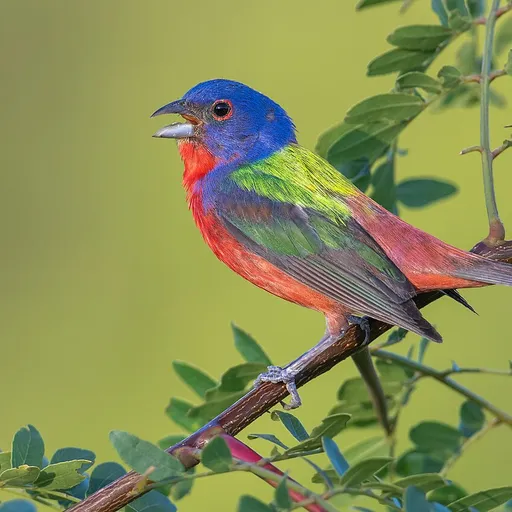
Painted Bunting
Passerina ciris
Least Concern
Overview
The painted bunting (Passerina ciris) is a small songbird native to North America, classified in the family Cardinalidae. It is currently listed as Least Concern on the IUCN Red List, though populations are declining in some areas due to habitat loss.
Identification
- Male plumage is strikingly multicoloured, featuring a dark blue head, green back, red rump, and red underparts, often described as the most beautiful bird in North America.
- Females and juveniles are a brighter, truer green than similar songbirds, providing effective camouflage.
- Adults measure 12–14 cm in length with a wingspan of 21–23 cm and weigh between 13–19 g.
- Males sing from exposed perches in spring and perform visual displays such as upright body-fluffing, bowing, and wing-quivering.
Habitat
This species inhabits thickets, woodland edges with riparian thickets, shrubbery, and brushy areas, as well as maritime hammocks in the east. Its breeding range is split into two geographically separate areas in southern Arizona, New Mexico, and the eastern/southern United States, with winters spent in South Florida, Cuba, the Bahamas, Mexico, and Central America.
Diet
Painted buntings feed by hopping along the ground and consume insects and seeds from grasses, sedges, and forbs. While they eat seeds almost exclusively in winter, they primarily seek small invertebrates, including spiders, snails, and caterpillars, during the breeding season.
Did you know?
The male painted bunting is so visually striking that it has been nicknamed the 'nonpareil,' meaning 'without equal.' It can also be difficult to spot despite singing because it often skulks in foliage to remain concealed.
Sources
- Wikipedia · CC BY-SA 4.0
- Wikidata · CC0 1.0