
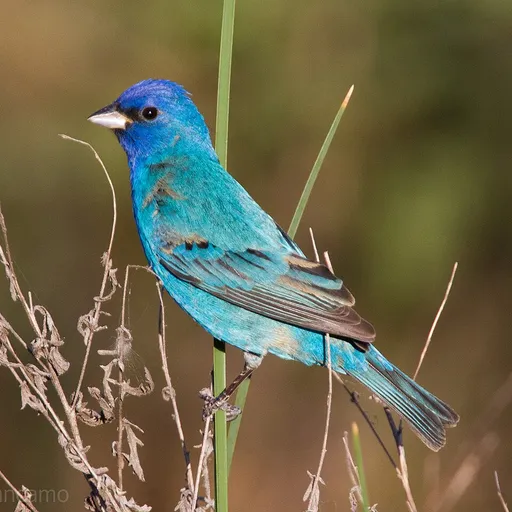
Indigo Bunting
Passerina cyanea
Least Concern
Listen
XC1006893 · Ryan Douglas · Mount Airy, Frederick County, Maryland, United States · CC BY-SA 4.0
Overview
The indigo bunting (Passerina cyanea) is a small, migratory songbird in the cardinal family that ranges from southern Canada to northern South America. It is a resident of farmland, brush areas, and open woodlands, and is classified as least concern by the IUCN Red List.
Identification
- Small bird measuring 11.5–15 cm in length with a short, conical beak.
- Adult males display vibrant cerulean blue plumage during the breeding season, with an indigo head and black wings and tail, while females and non-breeding males are brown.
- Females feature indistinct wing bars and faint darker streaks on the underparts, and the species has black or gray feet and legs.
- Males sing a high-pitched, buzzed song lasting two to four seconds to mark territory and attract mates.
Habitat
This species inhabits brushy forest edges, open deciduous woods, second growth woodland, and farmland, with breeding ranges extending from southern Canada to northern Florida and eastern Texas. Its winter range stretches from southern Florida and central Mexico through the West Indies and Central America to northern South America. Population increases have been observed following forest clearings and the development of land into farms.
Diet
The indigo bunting forages on the ground or in trees and shrubs, consuming a diet primarily of insects and seeds during the summer and grass seeds during the winter. Young are fed mainly insects to provide protein, and the species rarely drinks, obtaining sufficient water from its food. While solitary during the breeding season, it often feeds in flocks with other buntings in winter.
Did you know?
Indigo buntings migrate at night using the stars for navigation, relying on clues from the northern sky rather than individual stars or general brightness to orient themselves. They are also known to migrate across the Gulf of Mexico without stopping, provided they have accumulated enough fat to sustain the 600-mile journey.
Sources
- Wikipedia · CC BY-SA 4.0
- Wikidata · CC0 1.0