
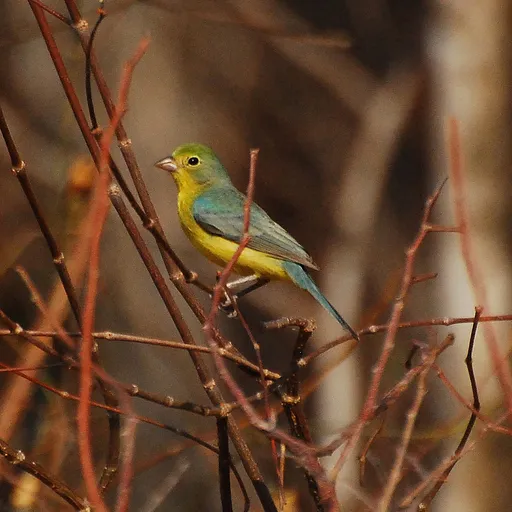
Orange-breasted Bunting
Passerina leclancherii
Least Concern
Overview
The orange-breasted bunting (Passerina leclancherii) is a small passerine bird in the family Cardinalidae, endemic to Mexico. It is classified as 'Least Concern' by the IUCN due to its wide range and large population size.
Identification
- Males exhibit a pale green crown, turquoise blue nape and upper parts, and canary yellow lores and eye-ring that deepen to golden-orange on the breast.
- Females possess greyish-green upper parts and yellow underparts, while the iris is dark brown and the beak and legs are grey.
- The song is described as a rather plaintive warble, characterised by being slower and less drawn out than that of other members of its genus.
Habitat
Endemic to Mexico, this species inhabits tropical dry forests, arid scrubland, thorny thickets, and bushy deciduous woodland at altitudes up to approximately 900 m. It has a patchy distribution across a range of about 276,000 km², extending from the Pacific coast in southern Nayarit, Jalisco, Michoacán, and Guerrero to western Chiapas and inland to the western part of Puebla. Notably, the bird is more abundant in secondary growth than in undisturbed forest.
Diet
While the specific diet of the orange-breasted bunting has not been extensively studied, members of this genus are generally seed-eaters that also consume some fruit and invertebrates. In captivity, individuals will consume white millet, hemp seed, thistle seed, hard sweet apples, ant cocoons, and mealworms.
Did you know?
A population of orange-breasted buntings was introduced to the Hawaiian island of Oahu in 1941 but failed to establish a viable colony, becoming extirpated by 1952.
Sources
- Wikipedia · CC BY-SA 4.0
- Wikidata · CC0 1.0