
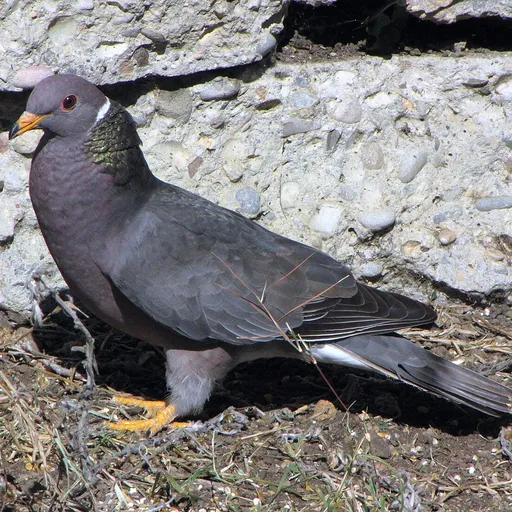
Band-tailed Pigeon
Patagioenas fasciata
Least Concern
Overview
The band-tailed pigeon (Patagioenas fasciata) is a large pigeon native to the Americas, classified as Least Concern on the IUCN Red List. It is one of the largest pigeons in the region and serves as a close living relative to the extinct passenger pigeon.
Identification
- Primarily gray plumage, somewhat darker above, with a faint pink cast on the head and underparts in adult males and a nearly white belly.
- Distinctive thin white collar on the nape, accompanied by green iridescence on the back of the neck in adults, which juveniles lack.
- Yellow bill and feet; the bill has a black tip in northern subspecies but is entirely yellow in southern subspecies.
- Low-pitched, owl-like two-syllable call that rises and falls (described as 'huu-ooh'), along with a distinctive wing whistle during flight.
Habitat
Band-tailed pigeons are found from British Columbia and the western United States south through Mexico, Central America, and down the Andes to northern Argentina. They inhabit damp forests, coniferous woods, oak woodlands, and scrublands, often at higher elevations, and roam throughout the year without a fixed home range.
Diet
These nomadic feeders travel up to 5 km from their nests to forage on the forest floor and from trees, primarily consuming acorns, though they also eat berries, seeds, flowers, leaves, and insects. Their diet shifts with the seasons, and in times of scarcity, they may venture into urban areas such as suburban parks and orchards.
Did you know?
The band-tailed pigeon was recently found to host the parasitic louse Columbicola extinctus, which was previously believed to have gone extinct with the passenger pigeon. Additionally, they commonly congregate at and drink from mineral springs, though the biological reason for this behaviour remains unknown.
Sources
- Wikipedia · CC BY-SA 4.0
- Wikidata · CC0 1.0