
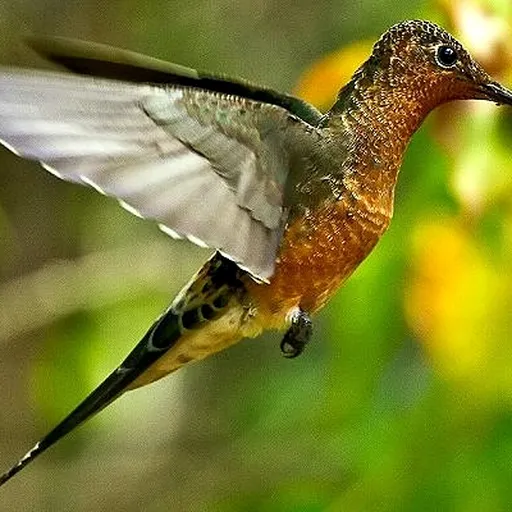
Giant Hummingbird
Patagona gigas
Least Concern
Overview
The giant hummingbird (Patagona gigas) is the largest species of hummingbird, characterised by a slender build and long bill that make its body appear smaller relative to its total length. It is listed as Least Concern on the IUCN Red List and is noted for having no close living relatives within the hummingbird family.
Identification
- Large size comparable to a European starling or northern cardinal, but with a notably slender build and long, straight bill that exceeds the length of the head.
- Dull colouration with a distinct eye-ring and very long wings that reach the tail tip when stowed.
- Tarsi are feathered to the toes and the feet are large and sturdy, with no visible sexual dimorphism.
- Produces a distinctive loud, sharp, and whistling "chip" voice.
Habitat
The species resides at high altitudes where thin air and low oxygen levels challenge its physiology, indicating it operates near the viable maximum size for a hummingbird. Its range extends across South America, with subspecies previously distributed from southwest Colombia through Chile to northwestern and central-southern regions, including Argentina.
Diet
Feeds primarily on nectar from flowers, including those of the Puya genus and columnar cacti, while also consuming insects to supplement protein and mineral intake. Females ingest calcium-rich materials such as sand, soil, slaked lime, and wood ash to replenish reserves used in egg production.
Did you know?
The giant hummingbird occasionally glides in flight, a behaviour extremely rare among hummingbirds, enabled by its elongated wings which allow for more efficient gliding than in other species. Its resting heart rate is 300 beats per minute, peaking at 1020 beats per minute during flight.
Sources
- Wikipedia · CC BY-SA 4.0
- Wikidata · CC0 1.0