
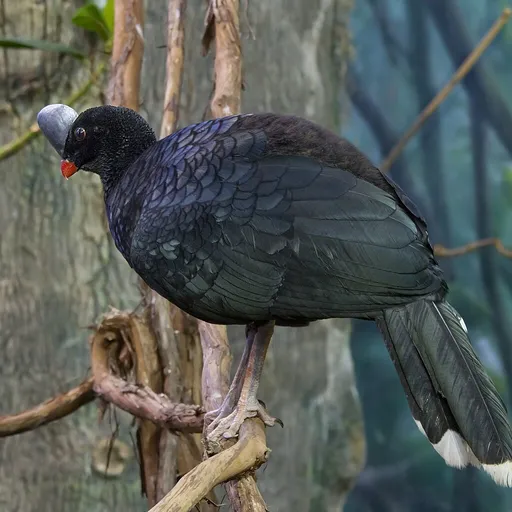
Helmeted Curassow
Pauxi pauxi
Vulnerable
Overview
The helmeted curassow (Pauxi pauxi), also known as the northern helmeted curassow, is a large terrestrial bird in the family Cracidae. It is classified as Endangered due to rapidly declining populations.
Identification
- Large terrestrial black bird measuring 80 to 100 cm in length.
- Features a distinctive large bluish grey casque on the forehead and a red bill.
- Plumage includes white underparts, a white-tipped tail, and greenish glossed mantle and breast feathers.
- Males weigh approximately 3.6 kg, while females are smaller at 2.6 kg, with both sexes appearing similar.
Habitat
Found in subtropical cloud-forests within steep, mountainous regions of western Venezuela and northern Colombia. It inhabits the eastern Andes, specifically the Cordillera de Mérida and Cordillera Oriental in Colombia, and the Serranía del Perijá. This species primarily occupies the lower strata, forest floor, and subcanopy of its forest habitat.
Diet
The diet consists mainly of seeds, fruits, insects, and small animals. No specific foraging methods beyond the consumption of these items are detailed in the reference material.
Did you know?
The helmeted curassow likely originated as a lineage in the Late Miocene, approximately 8 to 7 million years ago, and its current distribution suggests it became isolated around 6 million years ago due to mountain uplift.
Sources
- Wikipedia · CC BY-SA 4.0
- Wikidata · CC0 1.0