
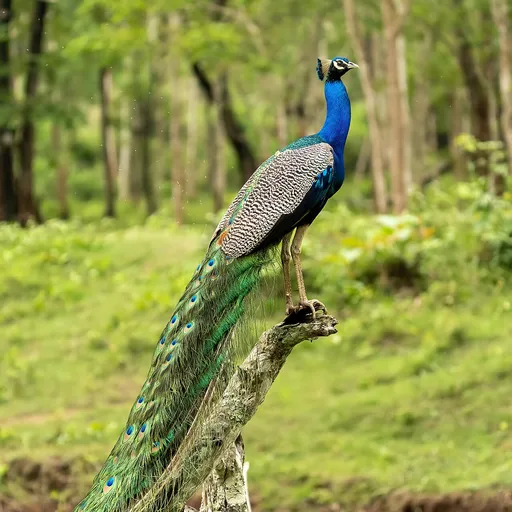
Indian Peafowl
Pavo cristatus
Least Concern
Listen
XC902565 · Kalle Nibbenhagen · Vörstetten, Freiburg, Baden-Württemberg, Germany · CC BY-SA 4.0
Overview
The Indian peafowl (Pavo cristatus), also known as the common peafowl or blue peafowl, is a species of peafowl native to the Indian subcontinent. Males, referred to as peacocks, are distinguished by their elaborate trains, while females are known as peahens. Although it originated in the Indian subcontinent, it has been introduced to many other parts of the world.
Identification
- Males possess a metallic blue crown with a fan-shaped crest and a long train of bronze-green feathers ending in colourful eyespots, whereas females are predominantly brown with a white face and iridescent green lower neck.
- Males measure 100–120 cm in bill-to-tail length and weigh 4.1–5.2 kg, with the train extending the total length to 200–230 cm; females are smaller at around 97 cm and weigh 2.7–4.1 kg.
- Males make loud calls, including a pia-ow or may-awe sound, which often signal the presence of predators, while the male displays by raising and quivering its train feathers during courtship.
- Both sexes have dark brown eyes, brown beaks and legs, and males possess a spur on the leg above the hind toe.
Habitat
Native to the Indian subcontinent, the species is found across most of India and Sri Lanka, inhabiting forests, small hills, and bushy areas near water sources as well as cultivable lands. It resides at elevations up to 1,500 m in the north and 1,800 m in the south, and has become feral in many other parts of the world where it has been introduced.
Diet
The Indian peafowl is omnivorous and forages on the ground in small groups, feeding on grass, seeds, flowerbuds, fruits, insects, and small reptiles such as lizards and rodents. Around human settlements, it may consume food scraps and crops such as peanuts, tomatoes, paddy, chili peppers, and bananas.
Did you know?
The function of the male's elaborate train has been debated for over a century, with Charles Darwin famously finding it a puzzle for natural selection before proposing sexual selection, while later theories suggest the train acts as a handicap signalling the male's fitness.
Sources
- Wikipedia · CC BY-SA 4.0
- Wikidata · CC0 1.0