
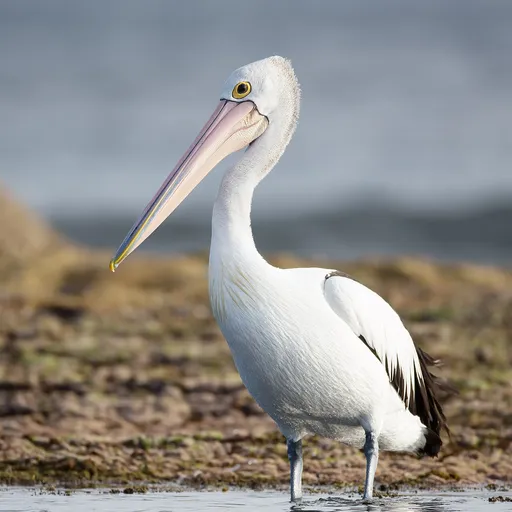
Australian Pelican
Pelecanus conspicillatus
Least Concern
Listen
XC1073374 · Rob Nicholson · Sandy Camp Road Wetlands Reserve (near Wynnum West), Brisbane City, Queensland, Australia · CC BY 4.0
Overview
The Australian pelican (Pelecanus conspicillatus) is a large waterbird in the family Pelecanidae, characterised by its predominantly white plumage and pink bill. It is widespread on the inland and coastal waters of Australia, New Guinea, and parts of the Pacific region, and is classified as a species of Least Concern on the IUCN Red List.
Identification
- Predominantly white body with black flight feathers and a large, pinkish bill.
- Total length ranges from 152 to 188 cm, boosted by the enormous bill which can reach 50 cm in length.
- During the breeding season, the orbital skin and distal bill turn orange, while the pouch may appear dark blue, pink, or scarlet.
- Juveniles resemble adults but feature brown instead of black feathers and a reduced white patch on the upper wing.
Habitat
The species primarily occupies large expanses of open water, including lakes, rivers, estuaries, coastal lagoons, and artificial reservoirs, without dense aquatic vegetation. Its range covers mainland Australia, Tasmania, New Guinea, and parts of Indonesia, Fiji, and the Pacific Islands, where it follows food availability rather than a fixed migration schedule.
Diet
Australian pelicans mainly feed on fish, including native and introduced species such as goldfish and carp, but also consume crustaceans, insects, small mammals, and occasionally other birds. They forage by plunge-diving while swimming or working in groups to drive prey into shallow water, where they snatch it with their sensitive bills.
Did you know?
The Australian pelican holds the record for the longest bill of any living bird, with specimens measured at 50 cm in length. In rare instances, they have even been reported to swallow small dogs whole.
Sources
- Wikipedia · CC BY-SA 4.0
- Wikidata · CC0 1.0