
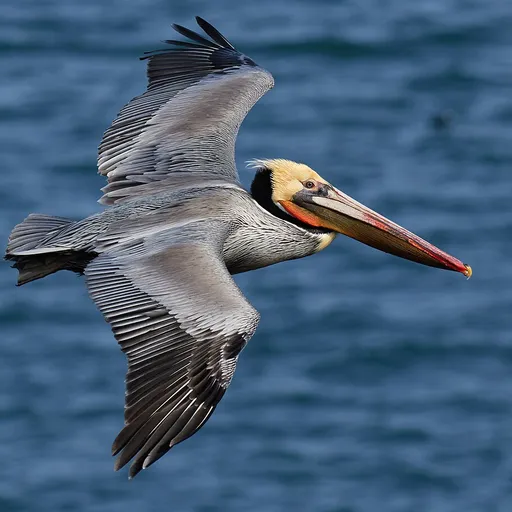
Brown Pelican
Pelecanus occidentalis
Least Concern
Overview
The brown pelican (Pelecanus occidentalis) is a seabird in the family Pelecanidae and the smallest of the eight extant pelican species. It is one of two species that feed by diving into water, a trait shared with the Peruvian pelican. Although currently rated as Least Concern, it was listed as endangered in the United States from 1970 to 2009 due to pesticide threats.
Identification
- In breeding plumage, the bird has a white head with a yellowish wash on the crown, dark maroon-brown nape and neck, and a short, deep chestnut crest.
- Adults measure 1 to 1.52 m in length with a wingspan of 2.03 to 2.28 m, and possess a very long bill measuring 280 to 348 mm.
- The lower mandible is blackish with a greenish-black gular pouch, while the legs and feet are black.
- It produces harsh, grunting sounds, such as a low-pitched 'hrrraa-hrra', during displays, and young frequently squeal.
Habitat
Found on the Atlantic, Gulf, and Pacific coasts of the Americas, from New Jersey to the mouth of the Amazon and from British Columbia to northern Peru, including the Galapagos Islands. It is a strictly marine species that inhabits warm estuarine and pelagic waters, mangrove swamps, and shallow waters near salty bays, rarely venturing more than 20 miles from the coast.
Diet
Primarily a piscivore, the brown pelican feeds on fish such as menhaden, anchovy, and sardines, while occasionally eating crustaceans, amphibians, and bird eggs or nestlings. It forages by diving bill-first from heights of 18 to 21 m, submerging completely to snap up prey before spilling the water from its throat pouch.
Did you know?
The brown pelican is exceptionally buoyant due to internal air sacks beneath its skin and in its bones, making it as graceful in the air as it is clumsy on land. It is also one of the few birds that can drink saline water directly due to the high capacity of its salt glands to excrete salt.
Sources
- Wikipedia · CC BY-SA 4.0
- Wikidata · CC0 1.0