
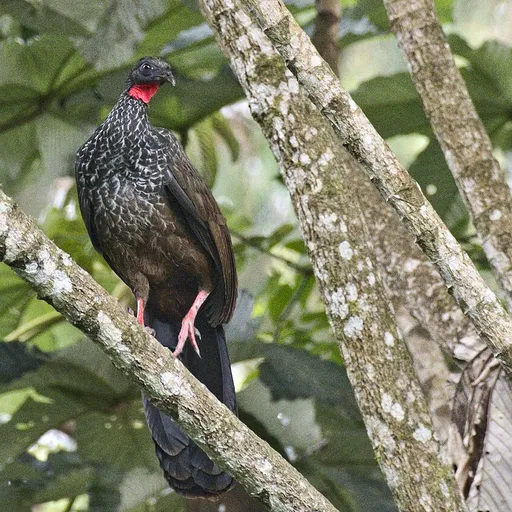
Cauca Guan
Penelope perspicax
Vulnerable
Overview
The Cauca guan, or Penelope perspicax, is a large, vulnerable bird species endemic to the humid forests of Colombia. Known locally as pava caucana, it leads a mostly arboreal lifestyle and was once thought to be extinct before small surviving populations were rediscovered.
Identification
- Large bird measuring c.75–85 cm with a plump body, long tail, and small head.
- Dark grey head, neck, and mantle that blend into a reddish chestnut rump, wings, and upper tail; under-tail feathers are grey.
- Prominent, bright red gular sac that is larger than that of the Andean guan, accompanied by red eyes and tarsi.
- Dark grey bill and mantle, throat, breast, and belly feathers outlined in white, creating a distinct scaled appearance.
- Vocalisations include a squawking alarm call, a long drawn-out "kōō'EEl" call, and loud morning wing-rattling used in courtship.
Habitat
Endemic to Colombia, the species is restricted to the Cauca River valley and the Pacific slope of the Cordillera Occidental, inhabiting humid primary and secondary forests, forest edges, and tree plantations between 900 and 2500 metres above sea level. Historically widespread, it now survives in four discontinuous sites within the departments of Cauca, Valle del Cauca, Quindío, and Risaralda.
Diet
Primarily a frugivore, the Cauca guan forages in trees and shrubs between 2 and 20 m above the ground, consuming fruit and occasionally leaves and flowers. During periods of fruit scarcity, it feeds heavily on the young leaves of introduced species such as Chinese ash. It also hunts for invertebrates on the ground, often following swarms of Army ants to capture fleeing prey.
Did you know?
The female incubates a clutch of two or three large white eggs weighing between 94 and 96 g, which is significantly heavier than an extra-large chicken egg.
Sources
- Wikipedia · CC BY-SA 4.0
- Wikidata · CC0 1.0