
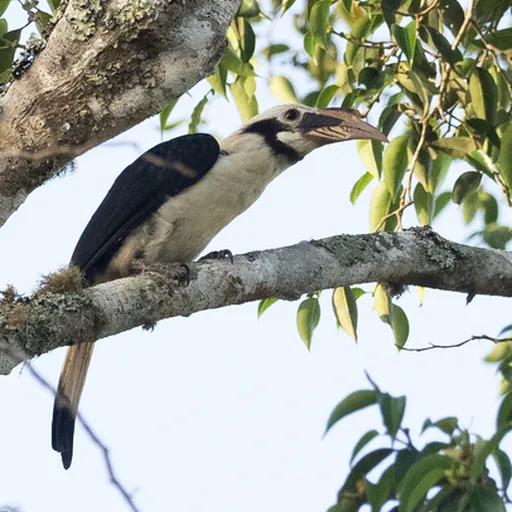
Mindanao Hornbill
Penelopides affinis
Least Concern
Overview
The Mindanao hornbill (Penelopides affinis), also known as the Mindanao tarictic hornbill, is a medium-small species of hornbill found in the canopy of rainforests in the southern Philippines. It is currently classified as Least Concern by the IUCN, although its population is declining due to habitat destruction, hunting, and the illegal wildlife trade.
Identification
- Bill and facial features: Fairly short bill with black bands; bare skin around the eyes and chin that is pale blue in males and darker blue in females.
- Plumage (Male): Pale underparts and head with a distinct black cheek, and a pale buffy tail tipped in black.
- Plumage (Female): Entirely black plumage with a buffy band through the center of the tail.
- Vocalisation: Noisy species emitting an incessant 'ta-rik-tik' call, which gives rise to its common name 'tarictic'.
Habitat
Found in tropical moist lowland forests in the canopy, primarily below 900 metres above sea level, though records exist up to 1,450 metres. Its range encompasses the islands of Mindanao, Dinagat, Siargao, and Basilan in the southern Philippines, with the basilanica subspecies restricted to Basilan.
Diet
Primarily frugivorous, feeding on figs and berries, but also consumes insects, lizards, and other small animals. The male is responsible for gathering food, which he stores in a gular pouch and regurgitates to feed his mate and chicks when they are in the nest cavity.
Did you know?
Despite being incredibly noisy and emitting incessant calls, these birds are difficult to spot in the field because they are well camouflaged by the dense foliage.
Sources
- Wikipedia · CC BY-SA 4.0
- Wikidata · CC0 1.0