
Allpahuayo Antbird
Percnostola arenarum
Vulnerable
Overview
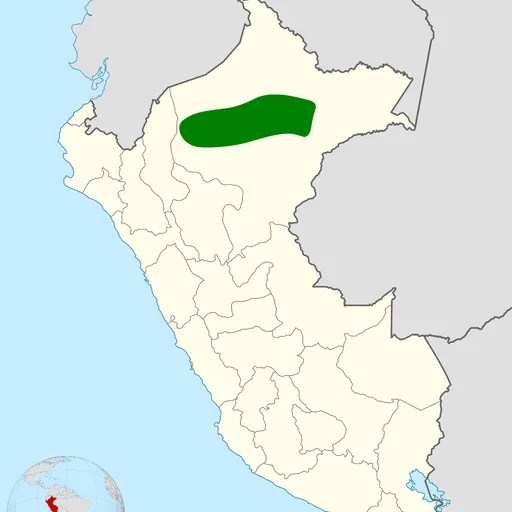
The Allpahuayo antbird (Percnostola arenarum) is a Vulnerable species of bird in the family Thamnophilidae, endemic to northeastern Peru. Formally described in 2001, this small antbird is known only from the Department of Loreto and is considered uncommon and local within its restricted range.
Identification
- Size: 13 to 15 cm (5.1 to 5.9 in) in length, with males weighing approximately 22.9 g and females 24.2 g.
- Plumage: Males are mostly dark gray with black wing coverts edged in white; females have dark gray upperparts, yellowish brown facial tinges, and reddish yellow-brown underparts, with some sub-populations showing tawny underparts.
- Bill and Legs: Males have an entirely black bill, while females have a black maxilla and bluish gray mandible; both sexes possess gray irises and bluish gray legs.
- Song: A moderately paced, slightly decelerating series of monotone whistles, often featuring a stuttered, higher-pitched introductory note.
Habitat
This species inhabits the understorey of a forest type locally called varillal on white sand soils, characterized by a stunted canopy and dense undergrowth, with a western sub-population found in irapayal forests. It is known only from the Department of Loreto in northeastern Peru, primarily in the drainages of the Nanay and Itaya rivers and along the Morona River, at elevations between 100 and 250 m.
Diet
The Allpahuayo antbird feeds on insects, though specific dietary details are unknown, and it forages in pairs or family groups on the ground or within 1 m of it by gleaning from vegetation and searching leaf litter. The western sub-population regularly follows army ant swarms to capture fleeing prey, a behaviour not observed in the eastern population.
Did you know?
The species' specific epithet, arenarum, is derived from the Latin word for "sand" to reflect its association with white sand soils, and its discovery was linked to a female specimen collected in 1998 that lacked the distinct underpart coloration of its sub-population, potentially indicating a second subspecies.
Sources
- Wikipedia · CC BY-SA 4.0
- Wikidata · CC0 1.0