
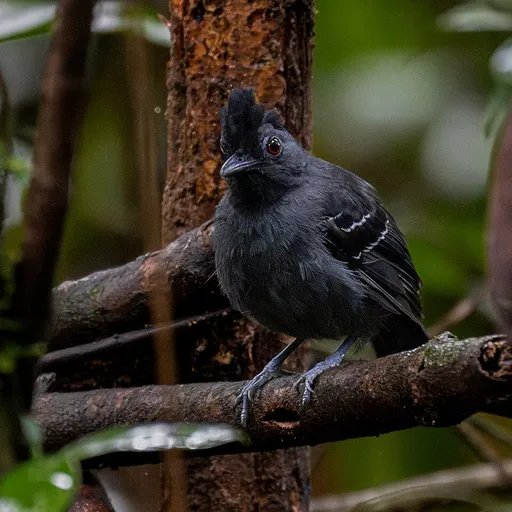
Black-headed Antbird
Percnostola rufifrons
Least Concern
Overview
The black-headed antbird (Percnostola rufifrons) is a passerine species within the typical antbird family. Classified as Least Concern by the IUCN, it maintains a stable population across a large range despite limited data on its total numbers.
Identification
- Measures 13 to 15.5 cm in length and weighs between 21 and 32 g.
- Males possess a black crown, short crest, and throat with grey bodies and blackish wings featuring white-tipped coverts.
- Females have rufous-brown upperparts and cinnamon-rufous underparts, with red irises in the nominate and subcristata subspecies, or grey irises in minor and jensoni.
- Song varies by region, described as high, decelerating 'tieew' notes in Brazil, or loud whistled 'pa, peer-peer-peer' sequences in Venezuela and Peru.
Habitat
Found across the Amazon Basin in Brazil, Colombia, French Guiana, Guyana, Peru, Suriname, and Venezuela, this species inhabits lowland and foothill terra firme evergreen forest and mature secondary woodland. It favours dense thickets, shrubby forest edges, and vegetated forest openings, reaching elevations of up to 350 m in Venezuela. Some subspecies also utilise sandy-soil forest and, in specific regions, mangroves or seasonally flooded areas.
Diet
This bird feeds on a wide variety of insects and arthropods, occasionally consuming small reptiles and fruit. Foraging typically occurs singly, in pairs, or in family groups, hopping through dense vegetation on the ground or just above it while pumping its tail. It captures prey by gleaning, jumping, lunging from perches, and searching leaf litter, and regularly follows army ant swarms although it remains subordinate to obligate ant-followers.
Did you know?
Although it routinely joins army ant swarms to capture fleeing prey, the black-headed antbird is subordinate to obligate ant-followers at these gatherings and seldom joins mixed-species feeding flocks.
Sources
- Wikipedia · CC BY-SA 4.0
- Wikidata · CC0 1.0