
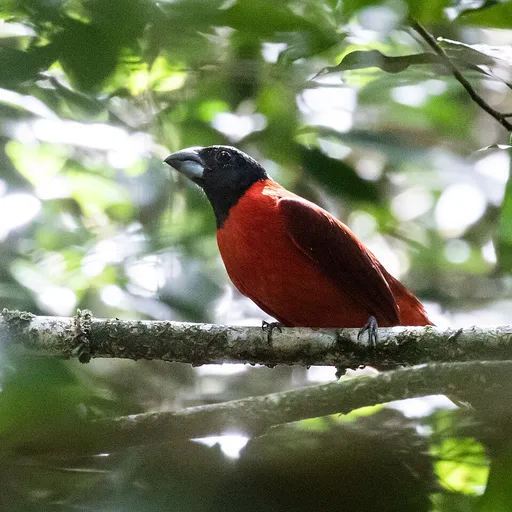
Red-and-black Grosbeak
Periporphyrus erythromelas
Overview
The red-and-black grosbeak (Periporphyrus erythromelas) is a species of bird in the family Cardinalidae. It is primarily distributed across northeastern South America, including parts of Venezuela, the Guianas, and Brazil.
Identification
- Length of 20.5 cm with a heavy bill, featuring a black maxilla and a silver-gray or pale blue-gray mandible with a black tip.
- Males possess a black head, bright red nape, breast, and belly, and a deep red back, while females have dark greenish-yellow upperparts and yellowish-green underparts with darker mottling.
- Both sexes exhibit dark brown irises and dark grayish black or pinkish gray legs.
- Singing involves an exceptionally sweet series of halting phrases that slide up and down, transcribed as "tuweé-tjuh-tejèh-tjuh", accompanied by a high-pitched, sharp "spink" call.
Habitat
This species inhabits mature humid terra firme and várzea forest. It ranges from the eastern edges of far eastern Venezuela through the Guianas into northeastern Brazil, reaching elevations of up to 1,000 m.
Diet
The red-and-black grosbeak forages in the lower levels of the forest for arthropods and seeds. It does not join mixed-species foraging flocks but instead feeds in pairs or family groups.
Did you know?
Although the bird was formally described in 1789, its breeding biology remains completely unknown.