
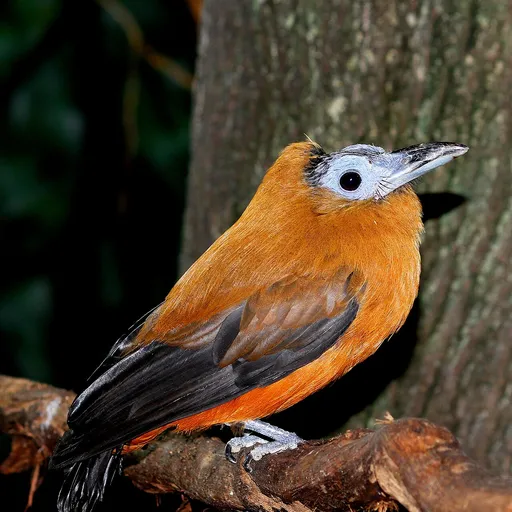
Capuchinbird
Perissocephalus tricolor
Least Concern
Overview
The capuchinbird, or Perissocephalus tricolor, is a large passerine bird of the family Cotingidae and is monotypic within its genus. It is currently classified as a species of Least Concern on the IUCN Red List.
Identification
- A large, thick-set suboscine passerine measuring approximately 40 cm in length and weighing between 340 and 420 grams.
- Features an overall rich brown plumage that approaches orange on the belly and undertail coverts, with black remiges and a short tail.
- Possesses a distinctive bare, almost vulture-like head covered in dull blue skin.
- Its 'song' is described as odd, often compared to the distant sound of a chainsaw or a young cow mooing.
Habitat
Found in humid forests in north-eastern South America, almost entirely north of the Amazon River and east of the Rio Negro. Its range extends up to 1,400 metres in elevation but is mostly below 600 m, covering Colombia, Venezuela, Brazil, and The Guianas.
Diet
The capuchinbird feeds mainly on fruits and insects. It gathers in leks where the males 'sing', and nests are typically located in close proximity to these mating sites.
Did you know?
It holds the distinction of being the largest suboscine passerine, with the exception of the Amazonian and long-wattled umbrellabirds. Notably, female capuchinbirds average larger in size than any female umbrellabird.
Sources
- Wikipedia · CC BY-SA 4.0
- Wikidata · CC0 1.0