
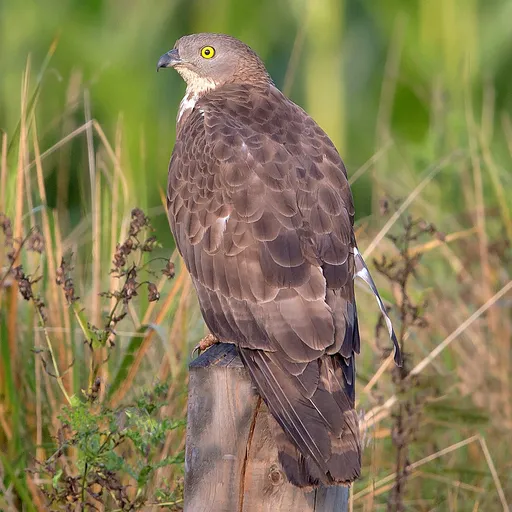
European Honey Buzzard
Pernis apivorus
Least Concern
Listen
XC1175973 · Sonothèque ADVL · Cabane Vauban (near Carolles), Manche, Normandie, France · CC0 1.0
Overview
The European honey buzzard (Pernis apivorus) is an insectivorous bird of prey in the family Accipitridae that breeds across Europe and western Asia before wintering in Africa. Classified as a species of Least Concern on the IUCN Red List, it is a long-distance migrant with a vast estimated range of 18,200,000 km².
Identification
- 52–60 cm long with a 130–150 cm wingspan, appearing longer-winged than a common buzzard but less heavy-bodied.
- Males feature a blue-grey head while females have a brown head, with the female being slightly larger and darker.
- Long tail with fewer bars than Buteo buzzards, typically displaying two narrow dark bars and a broad dark subterminal bar.
- Call consists of a clear peee-lu.
Habitat
The species prefers woodland, including plantations of exotic trees, and occupies a vast range spanning most of Europe, sub-Saharan Africa to western Russia, southwestern Siberia, and Kazakhstan. It is a summer migrant to the western Palearctic, absent only from the northern and northwestern fringes.
Diet
A specialist feeder, it lives mainly on the larvae and nests of wasps and hornets, although it also takes small mammals, reptiles, and birds. It spends large amounts of time on the forest floor excavating wasp nests, using long toes and claws adapted for raking and digging.
Did you know?
The bird possesses scale-like feathering on its head, thought to be a defence against the stings of its prey, and its feathers are believed to contain a chemical deterrent that protects it from wasp attacks. It is the only known predator in Europe of the invasive Asian hornet.
Sources
- Wikipedia · CC BY-SA 4.0
- Wikidata · CC0 1.0