
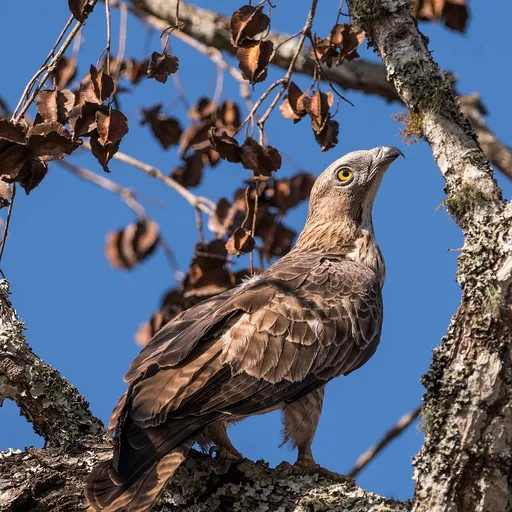
Crested Honey Buzzard
Pernis ptilorhynchus
Least Concern
Listen
XC875446 · Jairam Vijayan · Payyavoor, Kannur, Kerala, India · CC BY-SA 4.0
Overview
The crested honey buzzard (Pernis ptilorhynchus), also known as the Oriental or Asiatic honey buzzard, is a fairly large raptor in the family Accipitridae that is taxonomically closer to kites than to buzzards. It is a specialist feeder that primarily consumes the larvae of bees and wasps extracted from honeycombs, and is classified as Least Concern by the IUCN.
Identification
- Size and build: Approximately 57–60 cm in length, featuring long broad wings with six-fingered tips and a medium-length, broad tail with a rounded tip.
- Head structure: Possesses a small head and long neck that give it a pigeon-like appearance rather than a typical raptor look, along with a short head crest and an elongated head for foraging.
- Plumage and dimorphism: Brown above and paler below, with a dark throat stripe; males have blue-grey heads and brown irises, while females have brown heads, yellow irises, and slightly darker plumage.
- Field marks: Males display two black tail bands and three black underwing bands, whereas females have three tail bands and four narrower underwing bands; juveniles have extensive black primary tips.
Habitat
The species prefers well-forested lowland and hilly areas broken by open glades, occurring from sea level up to 1,800 m, though it may ascend above 3,000 m during migration. It migrates to breed in Siberia, Korea, and Japan, while wintering in tropical Southeast Asia and the Indian subcontinent, with some populations residing year-round in these warmer regions.
Diet
This specialist feeder lives mainly on the larvae and pupae of social bees and wasps, along with bits of comb and honey. It occasionally takes other small insect prey such as cicadas, as well as small birds, reptiles, and frogs.
Did you know?
The bird possesses a dense mat of short, stiff feathers on its head and neck that act like armour to repel stinging attacks, a study found, and it may also produce a chemical substance from its wings that renders wasps inactive.
Sources
- Wikipedia · CC BY-SA 4.0
- Wikidata · CC0 1.0