
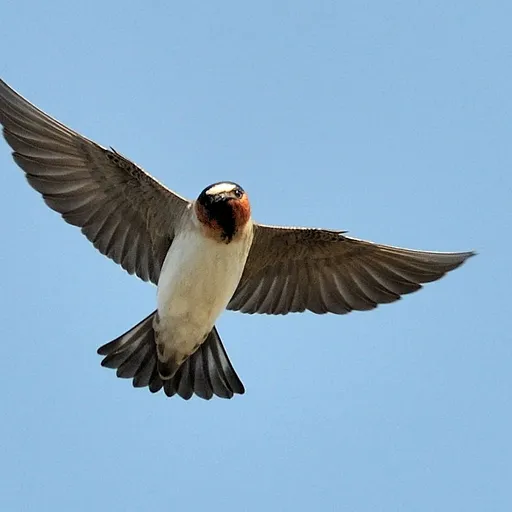
American Cliff Swallow
Petrochelidon pyrrhonota
Least Concern
Listen
XC254492 · Jonathon Jongsma · Wildlife Loop Rd, Custer State Park, South Dakota, United States · CC BY-SA 4.0
Overview
The American cliff swallow (Petrochelidon pyrrhonota) is a highly social passerine bird that forms massive nesting colonies of over 2,000 pairs. As an agile aerial insectivore, it is frequently observed foraging in large, tightly coordinated flocks over fields and marshes.
Identification
- Average body length of 13 cm with short legs, small bills, and long pointed wings.
- Dark brownish plumage on the back and wings with iridescent crowns and mantle in good light.
- Distinctive white forehead, rich red cheeks with a dark throat, white underparts, and a buffy rump.
- Square-shaped tail, lacking the forked tail of barn swallows.
- Northern populations are slightly larger than Mexican counterparts, which feature a chocolate-brown forehead patch.
Habitat
Historically nesting along mountain cliffs in western North America, the species has adapted to build gourd-shaped mud nests under bridges, on highways, and on buildings. Their breeding range spans much of Canada and the United States, excluding some far northern and southern areas, with wintering grounds in South America including southern Brazil, Uruguay, and parts of Argentina.
Diet
Cliff swallows feed exclusively on flying insects such as flies, bees, lacewings, mayflies, and moths. They forage at high altitudes of 50 metres or more over open fields and rely on bodies of water like ponds for shelter during high winds. Diurnal hunters, they return to their colonies at dusk in large, synchronised flocks known as creches.
Did you know?
This species is famous for its regular annual migration to the church at Mission San Juan Capistrano in California, an event that inspired Leon René's 1940 song, "When the Swallows Come Back to Capistrano". Additionally, cliff swallows are one of the few known vertebrates to make a competitively disadvantageous call to warn peers of a good foraging area, potentially sacrificing a private meal to benefit the colony.
Sources
- Wikipedia · CC BY-SA 4.0
- Wikidata · CC0 1.0