
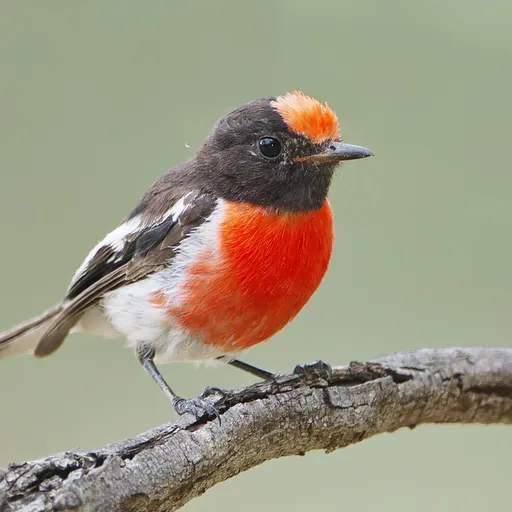
Red-capped Robin
Petroica goodenovii
Least Concern
Overview
The red-capped robin (Petroica goodenovii) is a small passerine bird native to Australia and classified as Least Concern on the IUCN Red List. It is the smallest of the red robins and is notably sexually dimorphic, with brightly coloured males and plain females. This species is not closely related to European or American robins but belongs to the Australian robin family, Petroicidae.
Identification
- Male plumage: Distinctive scarlet cap and breast, jet-black upperparts with white shoulder bars, and a black tail with white tips; all colours are sharply delineated.
- Female plumage: Undistinguished grey-brown above with a reddish tint to the crown, and paler underparts with dark brown wings and a pale buff wing-patch.
- Size and structure: Measures 10.5–12.5 cm in length and weighs 7–9 g; possesses a small, thin, black bill and dark brown eyes and legs.
- Song: Uses a variety of calls described as 'tinkle' and 'blurt' songs, which are similar across mainland Australia but distinct on Rottnest Island.
Habitat
Found across Australia except for Tasmania, Cape York, the Top End, and most of the Kimberley, with offshore populations on Rottnest Island and Greenly and Pearson Islands. It prefers arid habitats such as dry Acacia, Callitris, or mixed scrubland and woodland, inhabiting drier regions than its relative the scarlet robin. Although widespread, it is uncommon in many areas and rare east of the Great Dividing Range.
Diet
The diet consists of insects and other small arthropods, with beetles making up 96% of the diet in one study and the remainder consisting of ants. Other recorded prey includes spiders, grasshoppers, adult and larval butterflies and moths, dragonflies, and flies. The bird predominantly pounces on prey on the ground, but can also swoop to catch airborne creatures or glean from low-lying vegetation.
Did you know?
The generic name Petroica is derived from the Ancient Greek words petros 'rock' and oikos 'home', referencing the bird's habit of sitting on rocks.
Sources
- Wikipedia · CC BY-SA 4.0
- Wikidata · CC0 1.0