
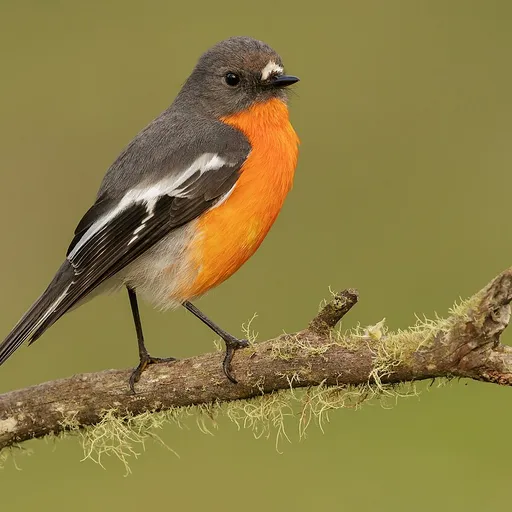
Flame Robin
Petroica phoenicea
Least Concern
Overview
The flame robin (Petroica phoenicea) is a small passerine bird native to the temperate regions of south-eastern Australia and Tasmania. As the largest of the red robins, it is a moderately common resident that is sexually dimorphic, with males displaying brilliant colouration and females appearing in muted tones.
Identification
- Males feature a brilliant orange-red chest and throat extending to the base of the bill, contrasting with iron-grey upperparts that have white bars and a white patch on the forehead.
- Females are a plain pale brown overall with lighter buff underneath and small off-white marks on the wings and above the bill.
- A small, thin black bill and dark brown eyes accompany the bird's slender build, which measures 12–14 cm in length.
- The song is highly musical and varied, often described as descending notes in groups of three likened to phrases such as "you-may-come, if-you-will, to-the-sea".
Habitat
Found in temperate regions of south-eastern Australia and throughout Tasmania, the species prefers wet eucalypt forest in hilly or mountainous areas during the breeding season, often at elevations up to 1,800 m. In autumn and winter, birds move to lower altitudes in open areas such as grasslands and woodlands containing river red gum and grey box. The flame robin is also frequently encountered in areas recently burnt by bushfires, although it moves away once undergrowth regrows.
Diet
The flame robin is predominantly insectivorous, pouncing on prey from a perch in a tree or foraging on the ground. During the breeding season, flies, butterflies, moths, caterpillars, and beetles predominate in the food fed to young birds.
Did you know?
A flame robin with an all lemon-yellow breast, otherwise resembling female plumage, was observed in a small flock near Swansea in eastern Tasmania in September 1950.
Sources
- Wikipedia · CC BY-SA 4.0
- Wikidata · CC0 1.0